
Vietnam property knowledge
Condo living in Hanoi: charges, sinking fund and co-ownership
What fees do you pay when owning a condo in Hanoi?
How co-ownership works in a Hanoi condominium
Vietnamese condominiums operate on a co-ownership model that will feel familiar to anyone who has owned a strata-titled apartment abroad. You own your unit outright — subject to the same 50-year, renewable-once term that applies to all foreign ownership of apartments in Vietnam — and you share the common areas (lobby, lifts, corridors, rooftop, car park, landscaping) with every other owner in the building. There is no private land title attached to a condo unit: as with all Vietnamese real estate, the land itself remains under state land-use rights, and what you hold is ownership of the building structure within an approved commercial housing project.
Day-to-day management sits with a Management Board (Ban quản trị), elected by owners at the building's Residents' Meeting (Hội nghị nhà chung cư), typically convened annually or whenever a quorum of owners requests it. The board sets the service charge, approves the annual budget, oversees the sinking fund and enforces the building's internal regulations (nội quy chung cư). Foreign owners can vote and stand for election on the same footing as Vietnamese owners, regardless of whether the building's 30% foreign-ownership quota is full — co-ownership rights are not affected by nationality, even though the purchase quota itself is.
Because you are buying into a shared structure rather than a standalone house, the health of this governance layer — a well-run board, transparent accounts, an adequately funded sinking fund — matters as much to your long-term costs as the price per square metre.
Most Hanoi towers hold their Residents' Meeting once a year, usually in the first quarter, to approve the previous year's accounts, confirm the coming year's service charge and elect or re-confirm the Management Board. Minutes and the approved budget should be shared with every owner. If you live overseas, you can generally authorise a representative, your property manager or a licensed proxy to attend and vote on your behalf — worth arranging before you leave Vietnam after signing, so your unit is never unrepresented when the budget or service charge is set.
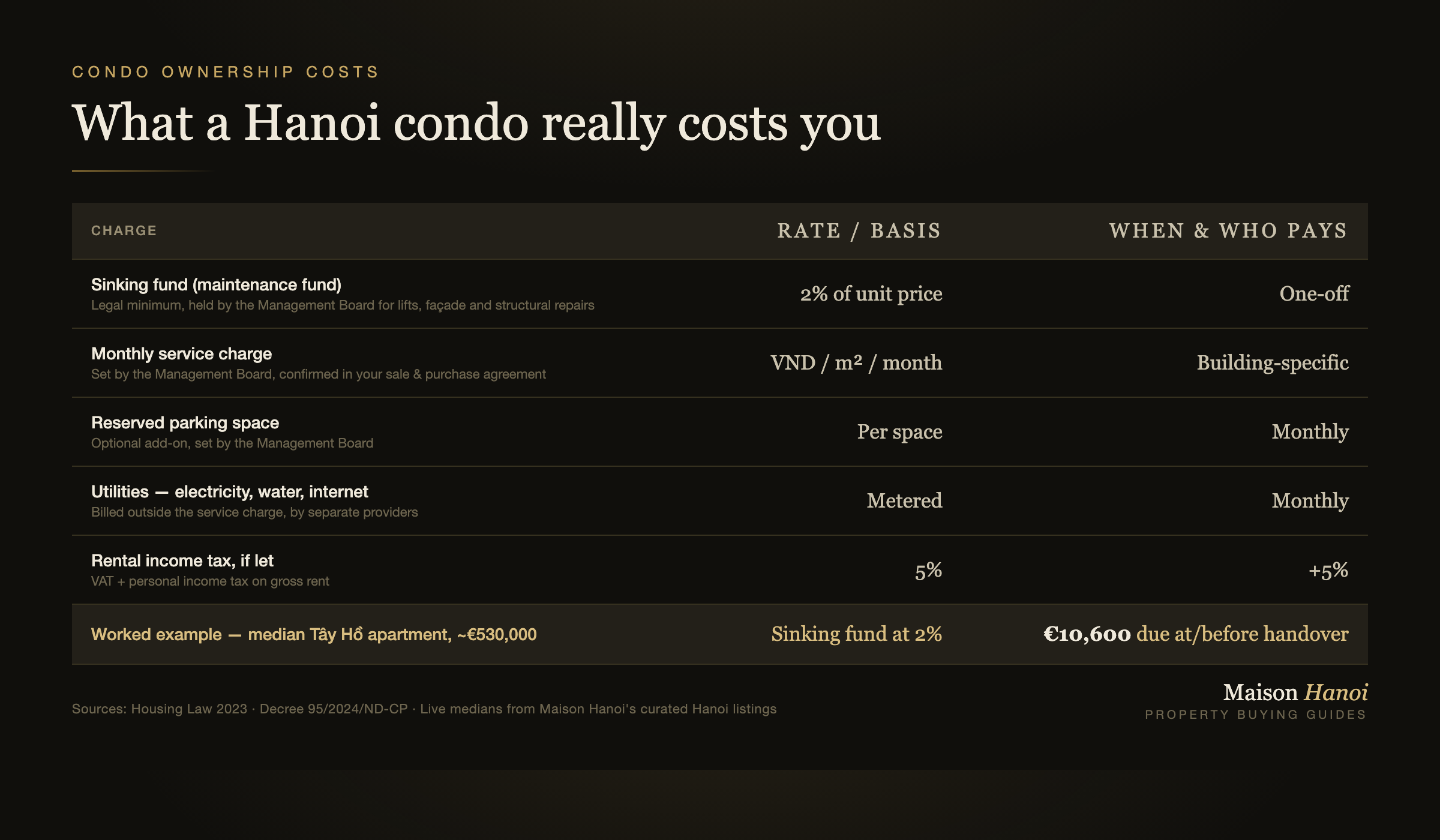
Typical condo ownership costs in Hanoi
The sinking fund is a fixed legal contribution; the monthly service charge is set individually by each building's Management Board and confirmed in your sale & purchase agreement — it is not a government-regulated rate. VND figures below are indicative, at an approximate exchange rate.
| — | Min | Max | Base |
|---|---|---|---|
| Sinking fund (maintenance fund)Legal minimum contribution held by the Management Board for major repairs — lifts, façade, structure (Housing Law 2023; Decree 95/2024/ND-CP) | 2% | 2% | % of unit price, one-offBuyer, at or before handover |
| Monthly service charge (phí dịch vụ)Confirmed in the SPA and the building's internal regulations (nội quy chung cư) before you sign | Set by Management Board | Varies by amenity tier | VND per m² per month, building-specificOwner, monthly |
| Reserved parking / motorbike space | Set by Management Board | Optional add-on | per space, monthlyOwner, if used |
| Utilities — electricity, water, internetBilled outside the service charge | Metered | Metered | usage-based, separate providersOwner or tenant, monthly |
| Rental income tax, if you let the unitSee our guide on renting out your property | 5% | 5% | VAT + personal income tax, on gross rentOwner, if renting out |
Worked example — median Tây Hồ apartment (~€530,000)
- Purchase price (median, Tây Hồ)
- €530,000 (~VND 13.78 billion)
- Sinking fund contribution, 2%, one-off
- €10,600 (~VND 275.6 million)
- Σ
- €10,600 due at/before handover, on top of the purchase price
Housing Law 2023 · Decree 95/2024/ND-CP · Live medians from Maison Hanoi's curated Hanoi listings
What's included, what isn't — and how to budget for it
The service charge typically bundles security, cleaning of common areas, lift maintenance, landscaping and basic insurance on the building's shared structure. It does not cover your own electricity, water or internet, which are metered and billed directly to your unit — nor does it include home-contents or liability insurance for your own apartment (see our home insurance guide for that separate layer). Reserved parking, if you want it, is usually a further monthly line set by the board.
If you plan to let the unit out, factor in a cost that sits entirely outside your condo charges: Vietnam applies a combined 5% VAT and 5% personal income tax on gross rental income for individual landlords, withheld or declared separately from anything the Management Board collects.
Before you buy, ask your agent or lawyer for the last two to three years of Management Board minutes and the sinking fund's current balance. A persistently underfunded fund — common in older or poorly managed towers — often means a large special assessment further down the line, split across every owner, foreign and local alike, regardless of how recently they bought. A clean set of accounts and a fully funded sinking fund are, in practice, a better predictor of your real cost of ownership than the advertised service-charge rate alone.
As a rule of thumb for budgeting: treat the service charge as a fixed monthly outgoing on top of your mortgage or rental yield calculation, and treat the 2% sinking fund as part of your total acquisition cost rather than a running expense — most buyers plan for it alongside the registration fee and notary costs in the months before handover, not afterwards.
Condo fees in Hanoi: frequently asked questions
What fees do you pay when owning a condo?
Two recurring layers: a monthly service charge set by the building's Management Board (covering security, common-area cleaning, lift maintenance and landscaping) and your own metered utilities. At purchase, new-build owners also pay a one-off 2% sinking fund contribution — a legal requirement, not a monthly cost.
What costs come with owning a condo?
Beyond the purchase price: the one-off 2% sinking fund, the monthly service charge, metered utilities, optional parking, home-contents insurance, and — if you rent the unit out — a combined 5% VAT and personal income tax on the rental income.
What is the downside of owning a condo?
You share control of common areas and budget decisions with the Management Board and other owners, and you cannot opt out of the service charge or sinking fund even if you rarely use shared facilities. Charges can also rise if the board approves a higher budget or a special assessment.
What am I responsible for when owning a condo?
Your own unit's interior, fixtures and any damage you cause; your share of the service charge and sinking fund as approved by the Management Board; and your own utilities, insurance and — if applicable — rental tax obligations.
What is included in condominium fees?
The standard service charge typically covers security, cleaning and upkeep of common areas, lift maintenance, landscaping and basic insurance on the building's shared structure. It does not cover your unit's own utilities, contents insurance or parking, which are usually billed separately.
Are condo fees the same as an HOA fee?
Conceptually yes — both fund the upkeep of shared areas and are set by an owners' body — but Vietnam's Management Board (Ban quản trị) operates under the Housing Law 2023 rather than a homeowners' association bylaw, and the one-off 2% sinking fund has no direct equivalent in most HOA structures.
Do condo fees still apply if I rent out my apartment?
Yes — the service charge and sinking fund are tied to the unit, not the occupant, so they remain payable whether you live there or rent it out. Rental income is taxed separately, at a combined 5% VAT and 5% personal income tax on gross rent.
Sources
- Housing Law 2023 (27/2023/QH15) — condominium co-ownership, the Management Board and the sinking fund / maintenance fund provisions.
- Decree 95/2024/ND-CP — implementing decree detailing condominium management and the 2% maintenance (sinking) fund contribution.
- Tổng cục Thuế — General Department of Taxation — VAT and personal income tax treatment of rental income for individual landlords.
Considering a condo in Hanoi?
Our advisory desk reviews the Management Board's accounts and sinking fund health before you commit — an independent second opinion, not a sales pitch. Tell us about the building and we'll come back within 24 hours.