
Comprendre l’immobilier vietnamien
Ce que les étrangers peuvent acheter au Vietnam : appartements, villas, maisons de ville et terrains
Quels types de biens les étrangers peuvent-ils acheter au Vietnam ?
Les quatre catégories, et la ligne qui compte vraiment
Demandez « que puis-je acheter au Vietnam ? » et la réponse honnête commence par une distinction, pas une liste. La loi vietnamienne reconnaît quatre grandes formes de biens résidentiels qu’un acheteur étranger est susceptible de rencontrer — appartements en copropriété, villas, maisons de ville et terrains — mais seulement trois d’entre elles sont réellement accessibles, et les trois sont soumises à la même condition fondamentale : vous devez acheter à l’intérieur d’un projet immobilier commercial approuvé pour la propriété étrangère. Rien acheté en dehors de ce périmètre, aussi attractif que soit l’annonce, ne peut être légalement enregistré au nom d’un étranger.
La quatrième catégorie, le terrain, est là où commence la plupart des confusions. Le Vietnam n’autorise pas la propriété privée du terrain pour quiconque, citoyen ou étranger : l’État en est propriétaire, et ce que l’acheteur acquiert réellement est un ensemble de droits d’usage du terrain. Les citoyens vietnamiens peuvent détenir ces droits sur une parcelle indépendante ; les particuliers étrangers ne le peuvent pas, sous aucune forme. Cette règle unique explique pourquoi une « villa » et un « terrain » ne sont pas interchangeables au Vietnam comme ils pourraient l’être ailleurs — une villa que vous pouvez posséder est un bâtiment, posé sur un terrain dont la propriété ne vous appartient jamais techniquement.
Parmi les trois catégories éligibles, les différences pratiques tiennent moins à la théorie juridique qu’à l’offre, au niveau de prix et au style de vie. Les appartements dominent le marché accessible aux étrangers ; les maisons avec terrain — villas et maisons de ville — existent dans un nombre plus restreint de communes agréées et sont soumises à leur propre quota. Nous détaillons chaque catégorie ci-dessous, puis comparons les trois côte à côte, avant d’expliquer pourquoi le terrain reste hors de portée et quelles sont vos options si une parcelle était ce que vous aviez en tête.
Copropriétés : le point d’entrée par défaut
Pour la grande majorité des acheteurs étrangers à Hanoi, la copropriété est le point de départ et souvent la destination. Un appartement dans un projet approuvé est l’actif le plus simple qu’un étranger puisse détenir : les formalités sont standardisées, le promoteur vérifie généralement le quota étranger pour vous, et le marché secondaire — autres propriétaires étrangers revendant à de nouveaux acheteurs étrangers, ou à des Vietnamiens — est de loin le plus profond des trois catégories.
La contrainte à prendre en compte est le quota de 30 % : au maximum trois unités sur dix dans un même bâtiment peuvent être détenues par des étrangers. Les bâtiments populaires dans des projets prisés peuvent atteindre ce quota bien avant leur achèvement, c’est pourquoi confirmer la disponibilité du quota est l’une des premières questions à poser à tout promoteur ou agent, et non une réflexion après coup au stade du contrat. La propriété elle-même est accordée pour un terme de 50 ans, renouvelable une fois, inscrit sur votre Livre Rose une fois l’enregistrement terminé.
Dans la catégorie copropriété, la taille des unités et le standing des bâtiments varient énormément — des petits appartements d’une chambre pour investissement aux résidences occupant un étage entier — mais les mécanismes de propriété ne changent pas. Ce qui change, c’est la liquidité et la demande locative, c’est pourquoi choisir le bon arrondissement est aussi important que choisir le bon bâtiment.
Villas et maisons de ville : maisons avec terrain dans des projets approuvés
Les villas et maisons de ville constituent le second niveau de ce que les étrangers peuvent posséder, et sont souvent mal comprises. Ce sont toutes deux des maisons avec terrain — isolée dans le cas d’une villa, mitoyenne ou semi-mitoyenne dans le cas d’une maison de ville — construites à l’intérieur du même type de projet immobilier commercial qui accueille les copropriétés. Vous possédez la structure et détenez les droits d’usage du terrain sur lequel elle est bâtie pendant la durée de votre terme ; vous ne possédez pas le terrain lui-même comme le ferait un citoyen vietnamien.
Le mécanisme de quota diffère de celui des appartements. Plutôt qu’un pourcentage par bâtiment, les maisons avec terrain sont limitées à 250 unités par quartier (un quartier étant une zone administrative locale d’environ 10 000 habitants) — un plafond partagé entre tous les acheteurs étrangers de ce quartier, non réinitialisé par projet. En pratique, cela signifie que la propriété de villas et maisons de ville par des étrangers est concentrée dans un nombre plus restreint de communes agréées construites spécifiquement pour vendre des maisons avec terrain aux acheteurs étrangers, plutôt que répartie uniformément dans la ville comme pour les appartements.
Pour un acheteur motivé par le style de vie — plus de jardin, plus d’intimité, de la place pour une famille — une villa dans l’une de ces communes approuvées est une option légitime et de plus en plus recherchée à Hanoi, à condition que le quota du quartier ait encore de la place et que l’approbation de la propriété étrangère du projet soit en cours de validité. Ces deux points valent la peine d’être vérifiés avant de vous décider sur une adresse précise ; notre guide de diligence raisonnable explique exactement comment faire.
Terrain : pourquoi il n’est pas en vente aux particuliers étrangers
La réponse la plus directe à « les étrangers peuvent-ils acheter un terrain au Vietnam ? » est non — ni un terrain de jardin, ni une terre agricole, ni un terrain nu à aménager et construire de zéro. Ce n’est pas une lacune de la loi qu’une structure astucieuse pourrait contourner ; c’est le principe fondamental de la propriété immobilière vietnamienne. Parce que toute la terre est détenue par l’État au nom du peuple, les droits d’usage sur une parcelle indépendante sont réservés aux citoyens vietnamiens et, depuis la Loi sur la terre 2024, aux Việt Kiều (Vietnamien d’outre-mer) dans des conditions proches de celles des citoyens.
Ce à quoi un acheteur étranger peut accéder, comme expliqué plus haut, est une structure — un appartement, une villa ou une maison de ville — à l’intérieur d’un projet où le promoteur détient déjà les droits d’usage du terrain et a obtenu l’approbation pour vendre la propriété étrangère des bâtiments qui y sont construits. C’est la seule voie vers quelque chose qui ressemble à un « terrain » pour un acheteur particulier étranger : ne pas posséder la parcelle, mais posséder ce qui est construit dessus, dans un projet conçu et agréé pour cela.
Deux catégories sont fermées même à cette voie. Rien dans une zone militaire ou de sécurité nationale désignée ne peut être vendu à un acheteur étranger en aucune circonstance, et un projet sans approbation actuelle de propriété étrangère ne peut légalement vous transférer le titre, peu importe ce que promet un vendeur. Ces deux vérifications doivent être faites dès le début de votre recherche, pas après qu’un acompte ait été versé.
Adapter la catégorie à ce dont vous avez réellement besoin
La bonne catégorie est rarement une question juridique une fois l’éligibilité confirmée — c’est une question d’usage que vous comptez faire du bien. Un acheteur étranger débutant qui privilégie la liquidité, la demande locative et une revente simple est généralement mieux servi par un appartement bien situé : le marché le plus profond, le processus le plus standardisé, et l’actif le plus facile à transmettre à un futur acheteur, étranger ou vietnamien. Consulter les appartements à vendre actuels est aussi, en termes pratiques, le moyen le plus rapide de tester le marché avant de s’engager dans une maison avec terrain.
Un acheteur qui déménage une famille, ou qui cherche un véritable domicile à long terme plutôt qu’un actif de portefeuille, tend à considérer plus sérieusement les villas et maisons de ville malgré le quota plus restreint et la liste plus courte de communes éligibles — le compromis est l’espace et l’intimité contre un marché plus petit et plus concentré. Consulter les villas à vendre et les maisons de ville à vendre côte à côte en fonction de la position du quota dans chaque quartier est la manière pratique de voir où le choix réel existe encore.
Quelle que soit la catégorie vers laquelle vous penchez, les contraintes sous-jacentes sont les mêmes : confirmez l’approbation de la propriété étrangère du projet, confirmez que le quota a de la place, et souvenez-vous que posséder l’un des trois ne confère aucun droit de résidence en soi — c’est une question distincte et entièrement séparée de la propriété.
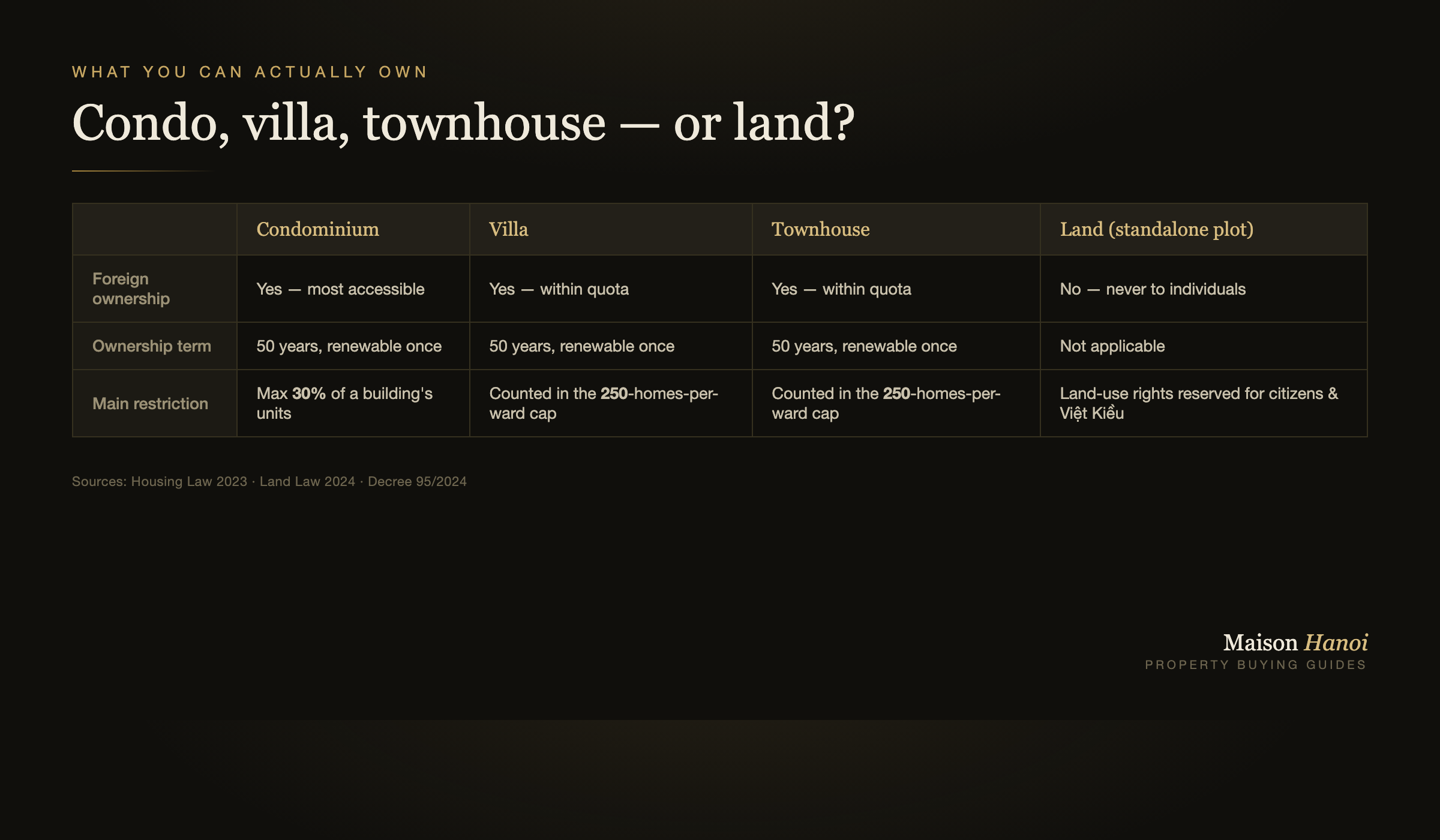
Types de biens en un coup d’œil
| Type de bien | Les étrangers peuvent-ils en être propriétaires directement ? | Durée de la propriété | Restriction principale |
|---|---|---|---|
| Appartement en copropriété | Oui, dans le quota | 50 ans, renouvelable une fois | Maximum 30 % des unités d’un bâtiment peuvent être détenues par des étrangers |
| Villa (maison avec terrain dans un projet approuvé) | Oui, dans le quota | 50 ans, renouvelable une fois | Comptabilisée dans le plafond de 250 maisons avec terrain par quartier |
| Maison de ville (maison avec terrain dans un projet approuvé) | Oui, dans le quota | 50 ans, renouvelable une fois | Comptabilisée dans le plafond de 250 maisons avec terrain par quartier |
| Terrain (parcelle indépendante, agricole ou vacante) | Non | Non applicable | Les droits d’usage sur une parcelle indépendante ne sont jamais vendus à des particuliers étrangers |
Questions fréquemment posées
Un citoyen américain peut-il acheter un appartement au Vietnam ?
Oui. La Loi sur le logement 2023 applique les mêmes règles à toutes les nationalités, y compris les citoyens américains : vous pouvez acheter un appartement dans un projet commercial approuvé pour la propriété étrangère, dans le quota de 30 % par bâtiment, pour un terme de 50 ans renouvelable une fois. Une entrée valide et légalement tamponnée sur votre passeport est requise pour acheter.
Un citoyen américain peut-il acheter une maison au Vietnam ?
Oui, dans certaines limites. Un citoyen américain — comme tout ressortissant étranger — peut acheter une villa ou une maison de ville dans un projet commercial approuvé, sous réserve du plafond de 250 maisons avec terrain par quartier. Ce qu’un citoyen américain ne peut pas acheter, c’est une parcelle indépendante ou une maison construite en dehors d’un projet approuvé.
Un non-citoyen peut-il acheter une maison au Vietnam ?
Oui, si la maison est une villa ou une maison de ville dans un projet agréé pour la propriété étrangère et que le quota de 250 unités du quartier a encore de la place. Un non-citoyen ne peut pas acheter une maison sur un terrain libre en dehors d’un tel projet, car cela nécessiterait des droits d’usage du terrain que la loi n’accorde pas aux étrangers.
Un Américain peut-il posséder un condo au Vietnam ?
Oui. Les acheteurs américains ne font face à aucune restriction particulière au-delà du cadre standard de propriété étrangère : un appartement dans un projet approuvé, limité à 30 % des unités du bâtiment, détenu pour un terme renouvelable de 50 ans et enregistré sur le Livre Rose une fois la vente finalisée.
Qu’est-ce qui vaut la peine d’être acheté au Vietnam ?
Pour la plupart des acheteurs étrangers, un appartement bien situé dans un projet approuvé offre le marché de revente le plus profond et le processus le plus simple. Les villas et maisons de ville conviennent aux acheteurs qui privilégient l’espace et un domicile à plus long terme, à condition que le quota du projet ait encore de la place. Le terrain lui-même n’est jamais une option pour un particulier étranger.
Les Américains peuvent-ils acheter des condos au Vietnam ?
Oui — les copropriétés sont la catégorie la plus accessible pour les acheteurs américains, comme pour toute nationalité. Les exigences sont les mêmes pour tous : un projet approuvé, un quota étranger disponible, une entrée légale au Vietnam, et l’enregistrement du terme renouvelable de 50 ans sur le Livre Rose.
Un étranger peut-il acheter un appartement au Vietnam ?
Oui. « Appartement » et « flat » désignent la même catégorie selon la loi vietnamienne : une unité à l’intérieur d’un projet immobilier commercial approuvé pour la propriété étrangère, soumis au quota de 30 % par bâtiment et à un terme de propriété de 50 ans renouvelable une fois.
Sources
- Loi sur le logement 2023 (Luật Nhà ở, No. 27/2023/QH15) — éligibilité à la propriété étrangère, quota de 30 % par bâtiment et terme de propriété renouvelable de 50 ans.
- Loi sur la terre 2024 (Luật Đất đai, No. 31/2024/QH15) — droits d’usage du terrain et exception d’éligibilité des Việt Kiều pour les parcelles indépendantes.
- Décret 95/2024/ND-CP — détail d’application de la Loi sur le logement 2023, incluant le plafond de 250 maisons avec terrain par quartier pour les villas et maisons de ville.
Vous ne savez pas quel type de bien correspond à vos projets ?
Dites-nous votre budget et l’usage que vous comptez faire du bien — investissement, déménagement ou résidence secondaire — et notre bureau conseil à Hanoi sélectionnera les appartements, villas ou maisons de ville éligibles et confirmera la disponibilité du quota sous 24 heures.