
Comprendre l’immobilier vietnamien
Le processus d'achat au Vietnam : chaque étape de la réservation au Sổ Hồng
Quel est le processus d'achat immobilier au Vietnam pour les étrangers ?
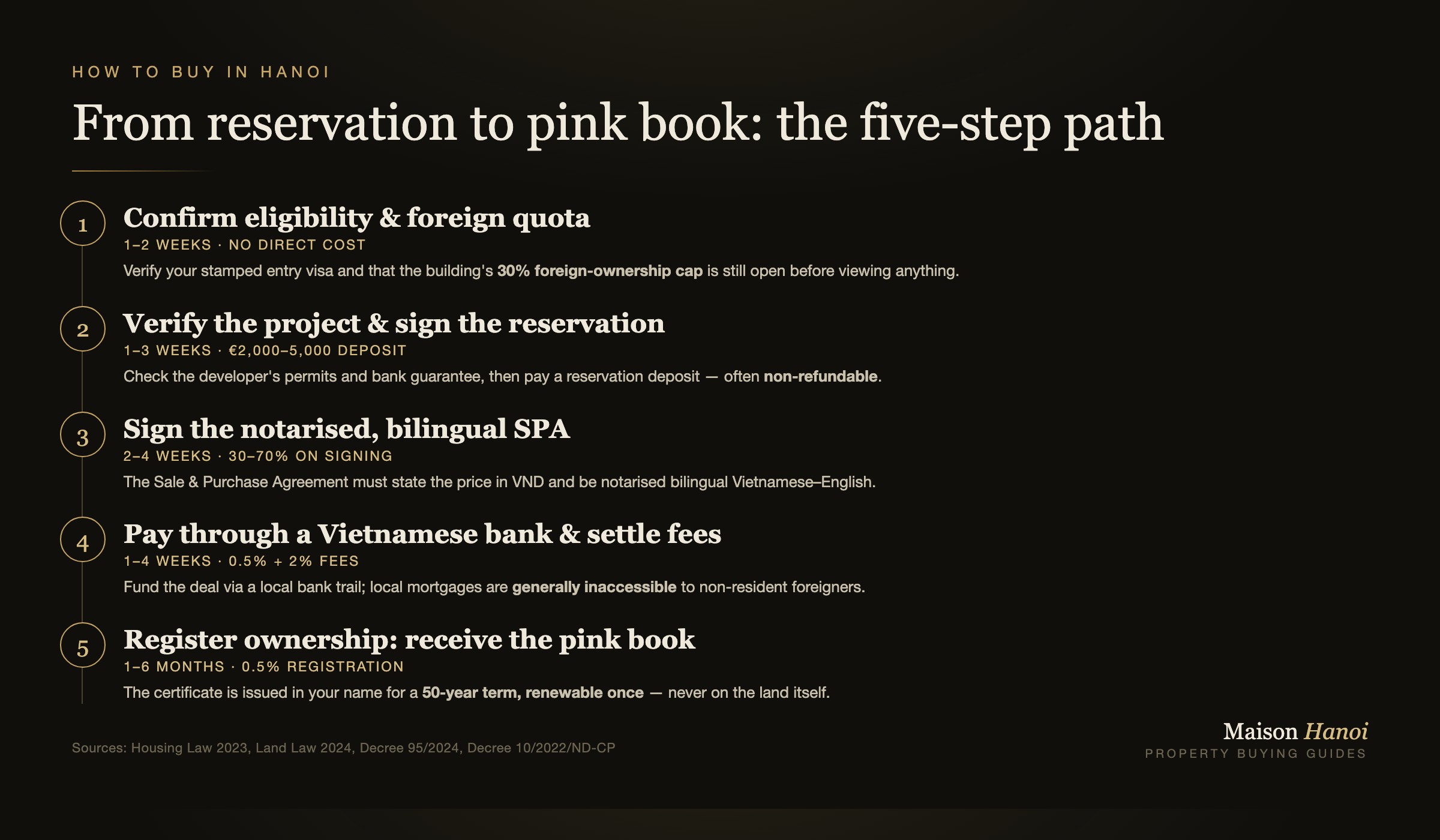
Les cinq étapes, de la réservation au Sổ Hồng
⏱ 3 à 6 mois (plus long pour l'achat sur plan)
- 1
Confirmez votre éligibilité et le quota étranger
⏱ 1 à 2 semaines◈ Aucun coût direct
Avant toute visite, confirmez que vous pouvez légalement acheter. Vous devez être entré au Vietnam avec un passeport valide et tamponné — l'achat lui-même ne vous confère aucun droit de résidence. Les étrangers ne peuvent posséder des appartements et des maisons que dans des projets commerciaux approuvés ; vous ne pouvez jamais posséder le terrain, seulement les droits d'utilisation du terrain enregistrés sur le Sổ Hồng, pour une durée de 50 ans, renouvelable une fois, selon la Loi sur le logement 2023. Chaque bâtiment est limité à 30 % d'appartements détenus par des étrangers (et une commune à 250 maisons étrangères), et les zones militaires ou de sécurité sont interdites. Demandez par écrit si le quota dans le bâtiment ciblé est encore disponible. Notre guide sur la loi immobilière vietnamienne et le quota étranger de 30 % couvre les règles en détail.
DocumentsPasseport valide avec tampon d'entrée vietnamien
⚠Supposer que l'achat confère un visa, ou se voir offrir un terrain à votre nom — aucune de ces options n'est possible pour un étranger.
- 2
Vérifiez le projet et signez la réservation
⏱ 1 à 3 semaines◈ Dépôt de 2 000 à 5 000 € (≈ 54 à 135 millions VND)
Une fois que vous avez choisi un bien, examinez attentivement le dossier du promoteur avant de vous engager : le permis de construire, les droits d'utilisation du terrain sur la parcelle, l'approbation officielle de la vente, et — pour un bien sur plan — une garantie bancaire valide (bảo lãnh) protégeant vos versements. Vérifiez de nouveau que le quota étranger du bâtiment n'a pas été épuisé depuis votre première demande. Vous signez ensuite un contrat de réservation et versez un acompte pour retirer l'unité du marché. Lisez notre checklist de diligence raisonnable pour vérifier le promoteur et le titre, et voyez quels programmes sont ouverts aux acheteurs étrangers dans nos programmes approuvés à Hanoi.
DocumentsPasseport · Contrat de réservation · Dossier juridique du promoteur
⚠Les dépôts de réservation sont souvent non remboursables — ne payez jamais avant de vérifier le quota et, pour un achat sur plan, la garantie bancaire.
- 3
Signez le contrat de vente bilingue notarié
⏱ 2 à 4 semaines◈ Échelonné : généralement 30 à 70 % du prix à la signature
Le contrat de vente (hợp đồng mua bán) est le document qui lie la transaction. Il doit indiquer le prix en đồng vietnamien, en toutes lettres et en chiffres, ainsi que le calendrier des paiements, les conditions de livraison et le nom exact de l'acheteur tel qu'il apparaît sur votre passeport. Exigez un texte bilingue vietnamien–anglais — le vietnamien prévaut, mais vous devez pouvoir lire ce que vous signez — et faites-le notarier, ce qui donne force légale au contrat. Notez que les Việt Kiều (Vietnamais d'outre-mer) bénéficient de droits quasi locaux depuis la Loi foncière 2024, donc un achat mixte peut suivre une procédure différente.
DocumentsContrat de vente bilingue · Traduction notariée du passeport · Passeport
⚠Signer un contrat uniquement en vietnamien ou non notarié, ou dont le nom ne correspond pas exactement à celui de votre passeport.
- 4
Organisez le paiement et réglez les frais
⏱ 1 à 4 semaines (selon calendrier)◈ Enregistrement 0,5 % + fonds de maintenance 2 %
Financez l'achat via une banque vietnamienne, selon le calendrier du contrat. Un prêt hypothécaire local est généralement inaccessible aux étrangers non-résidents, donc prévoyez de payer en espèces ou via les versements échelonnés du promoteur, en transférant des fonds de l'étranger vers un compte local. Conservez tous les reçus de transferts entrants : cette preuve de capital étranger vous permet de rapatrier les fonds lors de la revente. À ce stade, vous réglez aussi les frais légaux — la taxe d'enregistrement de 0,5 % et, pour une construction neuve, le fonds de maintenance de 2 % maintenance fund. Consultez notre guide du financement et du paiement, le détail complet dans taxes et frais à l'achat, et le taux EUR/VND à surveiller.
DocumentsReçus de virement bancaire · Preuve de capital étranger entrant · Reçus fiscaux et de frais
⚠Payer sans trace bancaire claire — cela complique la revente et le rapatriement des fonds ultérieurement.
- 5
Enregistrez la propriété et recevez le Sổ Hồng
⏱ 1 à 6 mois◈ Taxe d'enregistrement 0,5 %
La dernière étape est l'enregistrement du certificat des droits d'utilisation du terrain et de propriété de la maison — le Sổ Hồng (sổ hồng). Le vendeur ou promoteur dépose la demande, vous payez la taxe d'enregistrement de 0,5 %, et le certificat est délivré à votre nom avec la durée de 50 ans. Pour une revente, cela peut prendre des semaines ; pour un bien sur plan, cela suit la remise des clés et peut durer plusieurs mois. N'acceptez pas la remise sans un engagement écrit sur le délai du Sổ Hồng, et vérifiez que votre durée restante est correctement enregistrée. Conservez les reçus d'enregistrement avec vos documents fiscaux et de frais pour la revente éventuelle.
DocumentsContrat de vente signé · Procès-verbal de remise des clés · Reçus fiscaux · Passeport
⚠Accepter la remise sans délai clair pour le Sổ Hồng, ou ignorer que la durée de 50 ans a déjà commencé à courir.
Ce que coûte réellement l'achat à Hanoi
Les pourcentages ci-dessous sont les taux légaux ; l'exemple chiffré est basé sur la médiane de Tây Hồ à partir d'annonces en cours et mis à jour avec le marché. Voir la répartition complète dans notre <a href="/guides/taxes-fees">guide des taxes et frais</a>.
| — | Min | Max | Base |
|---|---|---|---|
| Taxe d'enregistrement | 0.5% | 0.5% | % du prix déclaréAcheteur, à l'enregistrement du Sổ Hồng |
| Fonds de maintenance / amortissementPayé une fois dans le fonds de fonctionnement de l'immeuble | 2% | 2% | % du prixAcheteur, constructions neuves |
| Notaire & traduction certifiée≈ 5 à 16 millions VND ; varie selon la valeur du contrat | €200 | €600 | Frais uniques |
| Conseil juridique indépendant / diligence raisonnableAvocat indépendant ou conseiller à l'achat | 0.5% | 1% | % du prix (optionnel)Acheteur, fortement recommandé |
| Total | ≈3% | ≈4% |
Exemple : un appartement à 530 000 € (≈ 14,3 milliards VND, médiane Tây Hồ)
- Taxe d'enregistrement 0,5 %
- €2,650 · ≈ VND 72M
- Fonds de maintenance 2 %
- €10,600 · ≈ VND 286M
- Notaire & traduction
- €400 · ≈ VND 11M
- Σ
- 13 650 € · ≈ 369 M VND
Decree 10/2022/ND-CP (registration fee) · Housing Law 2023 (maintenance fund) · Land Law 2024 · Decree 95/2024
Vérifiez à chaque étape avant de vous engager
Avant de réserver
3 ✓Éligibilité et projet
- Confirmez que votre passeport porte un tampon d'entrée vietnamien valideVous devez être entré légalement dans le pays pour être éligible à acheterRed flagOn vous dit que vous pouvez acheter entièrement à distance, sans jamais entrer au Vietnam
- Vérifiez que le quota de 30 % d'étrangers dans le bâtiment est encore disponibleDemandez au promoteur le nombre actuel d'unités détenues par des étrangers par écritRed flagSeule une assurance vague ou verbale que « il reste de la place »
- Vérifiez que le projet est un développement commercial approuvéLes étrangers ne peuvent acheter que dans des projets approuvés — jamais sur terrain nuRed flagUne offre d'enregistrer un terrain ou un titre foncier à votre nom
Avant de signer le contrat de vente
3 ✓Contrat et prix
- Confirmez le dossier juridique complet du promoteurPermis de construire, droits d'utilisation du terrain, approbation de vente et — sur plan — garantie bancaireRed flagAbsence d'approbation de vente, ou pas de garantie bancaire pour une tour sur plan
- Vérifiez que le prix est indiqué en VND, en toutes lettres et en chiffresLe contrat doit exprimer le montant sans ambiguïtéRed flagUn prix donné uniquement en devise étrangère, ou seulement en chiffres
- Assurez-vous que le contrat est bilingue et sera notariéLe vietnamien prévaut, mais une version anglaise doit le refléter exactementRed flagUn contrat uniquement en vietnamien que vous ne pouvez pas lire, ou sans notarisation
Avant la remise des clés et l'enregistrement
2 ✓Trace de paiement et titre
- Convenir d'un délai écrit pour le Sổ HồngLe contrat ou un annexe doit engager le vendeur aux démarches d'enregistrementRed flagAucun engagement sur la date de délivrance du Sổ Hồng
- Conservez la preuve de chaque transfert entrantLes reçus bancaires prouvent votre capital étranger pour une future vente ou rapatriementRed flagPayer en espèces, sans trace bancaire
Questions fréquentes
Un étranger peut-il acheter un bien immobilier au Vietnam ?
Oui. Les étrangers peuvent posséder des appartements et des maisons dans des projets commerciaux approuvés, limités à 30 % des unités d'un bâtiment selon la Loi sur le logement 2023. Vous ne pouvez pas posséder le terrain lui-même — seulement les droits d'utilisation — et vous devez être entré légalement au Vietnam pour acheter.
Combien de temps dure le processus d'achat ?
Typiquement de trois à six mois, du dépôt de réservation à la réception du Sổ Hồng. Les appartements en revente sont plus rapides ; les achats sur plan prennent plus de temps, car le certificat est délivré seulement après achèvement de la construction et remise officielle du bien.
Puis-je acheter un bien immobilier au Vietnam depuis les USA ou l'étranger sans visiter ?
En pratique, non. Vous devez avoir une entrée légale tamponnée pour être éligible, et le contrat de vente notarié est signé au Vietnam. Certaines étapes peuvent être déléguées via une procuration notariée, mais prévoyez au moins un voyage.
Combien de temps les étrangers possèdent-ils réellement le bien ?
Les acheteurs étrangers détiennent un terme de 50 ans, renouvelable une fois. Vous possédez le bâtiment, pas le terrain en dessous. Vendre à un ressortissant vietnamien peut convertir la durée, et le certificat (Sổ Hồng) indique toujours votre durée restante.
Les étrangers peuvent-ils obtenir un prêt hypothécaire au Vietnam ?
Les prêts bancaires locaux sont généralement inaccessibles aux étrangers non-résidents. La plupart des acheteurs paient en espèces ou utilisent le plan échelonné du promoteur et transfèrent des fonds de l'étranger. Notre guide de financement explique les options ; conservez tous les reçus de transfert.
Quelles taxes et frais s'appliquent à l'achat ?
Prévoyez environ 3 à 4 % en plus du prix : une taxe d'enregistrement de 0,5 % et, pour les constructions neuves, un fonds de maintenance de 2 %, plus les frais de notaire et les coûts juridiques optionnels. Le vendeur — pas l'acheteur — paie l'impôt sur le revenu personnel de 2 % lors d'une vente. Voir taxes et frais.
L'achat immobilier au Vietnam est-il sûr pour les étrangers ?
Cela peut l'être, à condition de vérifier les approbations du promoteur, le quota étranger du bâtiment et — pour un achat sur plan — la garantie bancaire, et d'utiliser un avocat indépendant via une diligence raisonnable appropriée. Le risque est procédural, non politique ; la plupart des problèmes proviennent de contrôles omis.
Sources
- Loi sur le logement 2023 (Luật Nhà ở, No. 27/2023/QH15) — éligibilité à la propriété étrangère, quota de 30 % par bâtiment et durée renouvelable de 50 ans.
- Loi foncière 2024 (Luật Đất đai, No. 31/2024/QH15) — droits d'utilisation du terrain et Sổ Hồng.
- Loi sur le commerce immobilier 2023 (Luật Kinh doanh Bất động sản, No. 29/2023/QH15) — approbations du promoteur et conditions de vente.
- Décret 96/2024/ND-CP — règles d'application de la Loi sur le commerce immobilier, y compris les garanties bancaires sur les ventes sur plan.
- Décret 95/2024/ND-CP — règles d'application de la Loi sur le logement (pas d'URL officiel anglais vérifié au moment de la rédaction).
- Décret 10/2022/ND-CP — fixe la taxe d'enregistrement de 0,5 % sur les transferts immobiliers (pas d'URL officiel anglais vérifié au moment de la rédaction).
Faites-vous accompagner par un conseiller à chaque étape
Notre bureau de Hanoi vérifie chaque semaine les quotas, approbations et contrats pour les acheteurs étrangers. Parlez-nous de votre achat et nous vous enverrons un second avis indépendant sous 24 heures — sans engagement, sans prospection.