
Vietnamesische Immobilien verstehen
Verkauf Ihrer Immobilie in Hanoi als Ausländer: Prozess, Steuern und Ausstieg
Kann ein Ausländer eine Immobilie verkaufen, die er in Hanoi besitzt?
Verkauf als Ausländer: Was unterscheidet sich vom lokalen Verkauf
Aktualisiert Juli 2026. Die Mechanik eines Ausstiegs basiert auf dem gleichen Rahmenwerk, das Ihnen den Kauf ermöglicht hat: das Wohnungsgesetz 2023 und das Landgesetz 2024 regeln, wer Ihre Einheit als nächstes halten darf und für wie lange. Vier Punkte bringen ausländische Verkäufer regelmäßig in Schwierigkeiten.
Wer darf von Ihnen kaufen
Sie können an einen vietnamesischen Staatsbürger verkaufen — was den Status der Einheit von einem begrenzten Ausländereigentumszertifikat in einen uneingeschränkten Titel auf den Namen des Käufers umwandelt und einen Platz in der 30%-Quote des Gebäudes freigibt — oder an einen anderen berechtigten Ausländer oder ausländisch investiertes Unternehmen, vorausgesetzt, das Gebäude hat die 30%-Ausländerquote noch nicht erreicht. Ein Käufer vietnamesischer Herkunft (Việt Kiều) mit bestätigter Herkunft hat nach dem Landgesetz 2024 nahezu gleiche Rechte wie ein lokaler Käufer und wird für Quoten-Zwecke wie ein vietnamesischer Käufer behandelt.
Was mit Ihrer 50-Jahres-Laufzeit passiert
Das Zertifikat, das Sie heute halten, läuft für den Rest seiner ursprünglichen 50-jährigen, einmal verlängerbaren Laufzeit — der Verkauf setzt diese Frist für einen ausländischen Käufer nicht zurück. Dieser erbt einfach die verbleibenden Jahre sowie Ihre Berechtigung, die eine erlaubte Verlängerung zu beantragen. Siehe unseren Leitfaden zur 50-jährigen Ausländereigentumsdauer und deren Verlängerung, wie sich das gegen Ende einer Laufzeit auswirkt.
Überweisung Ihrer Erlöse
Es gibt keinen informellen Bargeldkanal aus Vietnam: Verkaufserlöse werden über das Bankensystem abgewickelt und transferiert. Bewahren Sie Ihre Steuerzahlungsquittung und den notariell beglaubigten Übertragungsvertrag auf — Banken und lizenzierte Überweisungskanäle verlangen in der Regel beides, bevor sie eine Auslandsüberweisung bearbeiten.
Verkauf ohne Anwesenheit in Hanoi
Wenn Sie zum Zeitpunkt der Unterschrift nicht in Vietnam sind, ermöglicht eine notariell beglaubigte Vollmacht — ausgeführt bei einem vietnamesischen Konsulat im Ausland oder vor einem lokalen Notar und anschließend legalisiert — einem Vertreter, den Übertragungsvertrag zu unterschreiben und die Registrierung in Ihrem Namen durchzuführen.
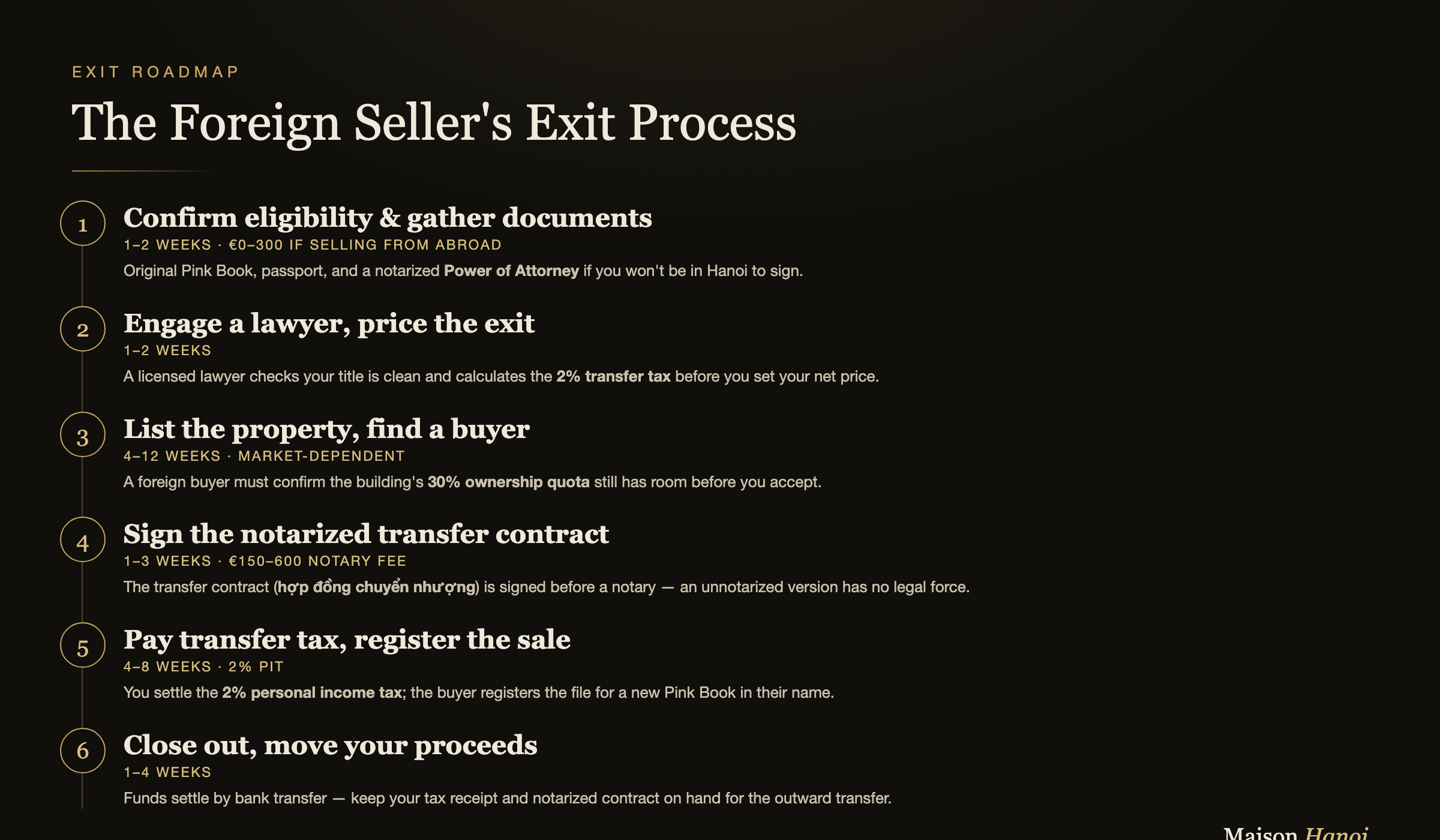
Der Ausstiegsprozess Schritt für Schritt
⏱ 3–6 Monate, vom Inserat bis zum neuen Pink Book
- 1
Bestätigen Sie Ihre Berechtigung und sammeln Sie Ihre Unterlagen
⏱ 1–2 Wochen◈ €0–300 für Dokumentenlegalisierung bei Verkauf aus dem Ausland
Sammeln Sie Ihr originales Pink Book (sổ hồng), Reisepass und — falls Sie nicht in Hanoi zur Unterschrift sind — eine notariell beglaubigte Vollmacht für einen lokalen Vertreter. Prüfen Sie, ob das Zertifikat frei von Hypotheken oder Streitvermerken ist, bevor Sie inserieren.
DocumentsOriginal Pink Book (sổ hồng) · Reisepass · Vollmacht, falls Verkauf aus dem Ausland
⚠Eine Einheit, die noch als Hypothek bei einer Bank belastet ist, kann erst übertragen werden, wenn diese Hypothek formell freigegeben ist.
- 2
Beauftragen Sie einen Anwalt und kalkulieren Sie den Ausstiegspreis
⏱ 1–2 Wochen◈ Anwaltskosten variieren je nach Umfang
Ein zugelassener Anwalt prüft, ob Ihr Eigentum sauber ist, entwirft oder überprüft den Übertragungsvertrag vor dem Käuferkontakt und berechnet Ihre 2% Übertragungssteuerpflicht, damit diese in Ihrem Nettopreis berücksichtigt wird. Siehe unsere vollständige Übersicht der Immobiliensteuern und -gebühren in Vietnam.
DocumentsGrundbuchauszug · Hypothekenfreigabeschreiben, falls zutreffend
⚠Eine Preisfestlegung ohne vorherige Bestätigung der Steuerbasis durch das lokale Finanzamt kann bei der Abwicklung zu Lücken führen.
- 3
Inserieren Sie die Immobilie und finden Sie einen Käufer
⏱ 4–12 Wochen, marktabhängig
Beauftragen Sie eine lizenzierte Agentur oder inserieren Sie selbstständig. Wenn Ihr potenzieller Käufer ebenfalls Ausländer ist, lassen Sie ihn bestätigen, dass die 30%-Ausländerquote des Gebäudes noch Kapazität hat — eine Übertragung, die die Quote überschreiten würde, kann nicht registriert werden, egal wie weit der Verkauf fortgeschritten ist.
⚠Die Annahme eines Angebots eines ausländischen Käufers ohne vorherige Quotenprüfung kann den Deal nach monatelangen Verhandlungen ungültig machen.
- 4
Unterschreiben Sie den notariell beglaubigten Übertragungsvertrag
⏱ 1–3 Wochen◈ Notargebühr nach Tarif (typischerweise €150–600, zwischen den Parteien verhandelbar)
Der hợp đồng chuyển nhượng (Übertragungsvertrag) wird von beiden Parteien — oder dem Vollmachtinhaber — vor einem Notar unterschrieben, mit dem Preis in Zahlen und Worten sowie einem klaren Zahlungsplan.
DocumentsNotariell beglaubigter Übertragungsvertrag · Reisepass / Ausweis beider Parteien
⚠Ein privater, nicht notariell beglaubigter Vertrag hat keine rechtliche Wirkung für die Übertragung — die Notarisierung ist verpflichtend, nicht optional.
- 5
Zahlen Sie die Übertragungssteuer und registrieren Sie die Eigentumsänderung
⏱ 4–8 Wochen◈ 2% Einkommensteuer auf den Übertragungspreis (Verkäufer)
Sie begleichen die 2% Einkommensteuer; der Käufer zahlt die Registrierungsgebühr und reicht die Unterlagen beim Bezirksgrundbuchamt ein. Ein neues Pink Book wird auf den Namen des Käufers ausgestellt, womit Ihr Eigentum endet.
DocumentsSteuerzahlungsquittung · Registrierungsantrag
⚠Ein deklarierter Preis, der im Vergleich zur vom Finanzamt verwendeten lokalen Preisspanne zu niedrig erscheint, kann die Registrierung monatelang verzögern.
- 6
Schließen Sie ab und überweisen Sie Ihre Erlöse
⏱ 1–4 Wochen
Sobald die Registrierung abgeschlossen ist, werden die Gelder per Banküberweisung abgewickelt. Bewahren Sie den notariell beglaubigten Vertrag und die Steuerquittung griffbereit auf — sie sind die Standardnachweise für jede internationale Weiterüberweisung.
DocumentsSteuerquittung · Notariell beglaubigter Vertrag · Banküberweisungsanweisungen
⚠Werden Ihre Belege zu früh weggeworfen, kann eine Bank Monate später eine Auslandsüberweisung verweigern.
Was der Verkauf kostet
Beispielrechnung für eine Wohnung im Wert von €530.000 — der aktuelle Median in Tây Hồ (Live-Daten).
| — | Min | Max | Base |
|---|---|---|---|
| Einkommensteuer (PIT) auf die ÜbertragungGebührenrahmen Wohnungsgesetz 2023 / Landgesetz 2024 | 2% | 2% | % des Vertrags- oder deklarierten Preises, je nachdem, was das Finanzamt anwendetVerkäufer, zu begleichen vor Annahme der Unterlagen zur Registrierung |
| Notarielle Beglaubigung des ÜbertragungsvertragsKeine feste staatliche Prozentzahl | €150 | €600 | einmalig, nach NotartarifTypischerweise zwischen Käufer und Verkäufer verhandelt |
| Verwaltungsgebühr für GrundbucheintragungStellt das neue Zertifikat auf den Käufer aus | — | — | Lokaler GebührentarifIn der Regel der Käufer — im Vertrag bestätigen |
| Lizenzierte Agenturprovision, falls genutztIm Inseratsmandat vereinbart, kein gesetzlicher Satz | Negotiated | Negotiated | Marktübliche Praxis, nicht gesetzlich festgelegtVerkäufer, falls eine Inseratsagentur beauftragt ist |
| Total | ≈2% (statutory PIT only) | ≈2.1% including notary costs |
Beispiel — Wiederverkauf einer Wohnung für €530.000 (Tây Hồ Median)
- Einkommensteuer (2%)
- €10,600 (~292M VND)
- Notarielle Beglaubigung
- €150–600 (~4–16M VND)
- Verwaltungsgebühr Grundbucheintragung
- Paid by the buyer
- Σ
- ≈ €10.750–11.200 (~296–308M VND) für den Verkäufer, ohne Agenturprovision
Housing Law 2023 · Land Law 2024 · Decree 95/2024/ND-CP
Häufig gestellte Fragen
Kann ich meine Immobilie in Hanoi an einen vietnamesischen Staatsbürger verkaufen?
Ja — dies ist in der Regel der unkomplizierteste Ausstieg. Nach der Registrierung wandelt sich der Titel der Einheit vom begrenzten Ausländereigentumszertifikat in einen uneingeschränkten Titel auf den Namen des Käufers, und der Platz, den sie in der 30%-Ausländerquote des Gebäudes innehatte, wird für andere Käufer frei.
Kann ich an einen anderen ausländischen Käufer verkaufen?
Ja, vorausgesetzt, die 30%-Ausländerquote des Gebäudes hat nach dem Eigentümerwechsel Ihrer Einheit noch Kapazität. Wenn das Gebäude bereits die Quote erreicht hat, kann eine Übertragung auf einen neuen ausländischen Eigentümer erst registriert werden, wenn wieder Kapazität verfügbar ist.
Welche Steuer zahle ich beim Verkauf?
Als Verkäufer zahlen Sie eine 2%ige Einkommensteuer auf den Übertragungspreis oder auf den Preis, den das lokale Finanzamt ansetzt, falls dieser höher ist. Dies ist getrennt von der Registrierungsgebühr, die der Käufer zahlt, und wird vor Annahme der Unterlagen zur Registrierung beglichen.
Muss ich in Vietnam sein, um den Verkauf abzuschließen?
Nein. Sie können eine notariell beglaubigte Vollmacht unterzeichnen — ausgeführt bei einem vietnamesischen Konsulat im Ausland oder vor einem lokalen Notar — die einen Vertreter bevollmächtigt, den Übertragungsvertrag zu unterschreiben und die Registrierung in Ihrem Namen durchzuführen.
Wie lange dauert der Verkauf von der Inserierung bis zum Abschluss?
Planen Sie ungefähr 3–6 Monate von Tür zu Tür ein. Die Käufersuche ist marktabhängig, während der notariell beglaubigte Vertrag, die Steuerzahlung und die Bearbeitung durch das Grundbuchamt typischerweise weitere 2–3 Monate nach Vertragsabschluss benötigen.
Was passiert, wenn ich kurz vor Ablauf meiner 50-jährigen Laufzeit verkaufe?
Die verbleibenden Jahre auf Ihrem Zertifikat gehen mit dem Verkauf über — Sie verkaufen keine neue 50-jährige Laufzeit. Ein vietnamesischer Käufer wandelt in einen uneingeschränkten Titel um; ein ausländischer Käufer erbt nur die verbleibenden Jahre plus die Berechtigung, die eine erlaubte Verlängerung zu beantragen.
Kann ich die Verkaufserlöse aus Vietnam transferieren?
Die Erlöse werden über das vietnamesische Banksystem abgewickelt, nicht bar. Bewahren Sie Ihre Steuerzahlungsquittung und den notariell beglaubigten Übertragungsvertrag auf, da Banken diese Dokumente in der Regel für die Bearbeitung einer Auslandsüberweisung verlangen.
Quellen
- Wohnungsgesetz 2023 (Gesetz Nr. 27/2023/QH15) — regelt die Berechtigung zum Ausländereigentum, die 30%-Gebäudequote und die 50-jährige Eigentumsdauer.
- Landgesetz 2024 (Gesetz Nr. 31/2024/QH15) — legt die bei Verkauf übertragenen Landnutzungsrechte und die Rechte von Việt Kiều-Käufern fest.
- Gesetz über Immobiliengeschäfte 2023 (Gesetz Nr. 29/2023/QH15) — regelt den notariell beglaubigten Übertragungsvertrag und den Registrierungsprozess.
- Verordnung 95/2024/ND-CP — Durchführungsverordnung zur Anwendung des Wohnungsgesetzes 2023 (zum Zeitpunkt der Erstellung keine verifizierte öffentliche URL).
- Generaldirektion für Steuern (Tổng cục Thuế) — verwaltet die 2%ige Einkommensteuer auf Immobilienübertragungen.
Planen Sie, Ihre Immobilie in Hanoi zu verkaufen?
Unser Beratungsdesk koordiniert Anwalt, Notar und Steuererklärung für ausländische Verkäufer, die Hanoi verlassen — von Quotenprüfungen bis zur Registrierung der Übertragung mit einem neuen Käufer. Erzählen Sie uns von Ihrer Immobilie und Ihrem Zeitplan; wir antworten in der Regel innerhalb eines Werktags.