
Vietnamesische Immobilien verstehen
Steuern und Gebühren beim Immobilienkauf in Vietnam
Welche Steuern und Gebühren zahlen Ausländer beim Immobilienkauf in Vietnam?
Wie Immobilien in Vietnam besteuert werden: was ausländische Käufer tatsächlich zahlen
Aktualisiert Juli 2026. Der Kauf einer Wohnung in Hanoi ist im Vergleich zu den meisten europäischen Märkten erfreulich steuerleicht — aber die Kosten sind anders strukturiert, und einige davon überraschen ausländische Käufer bei der Abwicklung. Dieser Leitfaden erläutert jede Abgabe, die Sie erwarten, wer sie zahlt und wann, basierend auf den im Wohnungsrecht 2023 und Landrecht 2024 festgelegten Gebührensätzen. Aktuelle Preise werden hier im Fließtext nicht genannt; für aktuelle Medianwerte nach Bezirk konsultieren Sie unsere Marktdaten.
Gibt es eine Grundsteuer in Vietnam?
Nein. Vietnam erhebt keine wiederkehrende jährliche Grundsteuer auf Wohnimmobilien vergleichbar mit der Grundsteuer, taxe foncière oder Grundsteuer. Sobald Sie das Pink Book (sổ hồng) besitzen, gibt es keine jährliche Rechnung allein für den Besitz Ihrer Wohnung. Die einzige laufende öffentliche Abgabe ist eine sehr geringe nicht-landwirtschaftliche Flächennutzungssteuer (thuế sử dụng đất phi nông nghiệp), berechnet auf Grundlage der Flächennutzungsrechte; für Wohnungseigentümer ist diese vernachlässigbar und wird üblicherweise auf Gebäudeebene beglichen. Ihre tatsächlichen laufenden Ausgaben sind privat — die Verwaltungs- und Servicegebühren, die vom Gebäude erhoben werden.
Was Sie beim Erwerb der Immobilie zahlen
Drei Posten machen den Großteil Ihrer Erwerbskosten aus. Erstens die Registrierungsgebühr (lệ phí trước bạ) von 0,5 % des deklarierten Werts, vom Käufer zu zahlen — diese Gebühr bewirkt die Ausstellung des Pink Book auf Ihren Namen. Zweitens bei einem Neubau, der vom Entwickler gekauft wird, ein einmaliger Instandhaltungsfonds von 2 % des Werts, der bei Übergabe eingezogen und vom Verwaltungsrat des Gebäudes für die Pflege der Gemeinschaftsflächen verwaltet wird. Drittens Notar- und Verwaltungsgebühren, die moderat sind und sich am Vertragswert orientieren.
Neubaupreise, die vom Entwickler genannt werden, enthalten in der Regel bereits die MwSt; Wiederverkäufe zwischen Privatpersonen unterliegen nicht der MwSt. Da sich der Satz und seine Ausnahmen periodisch ändern, führen wir die aktuelle Zahl in einem eigenen Erklärtext — sehen Sie, wie hoch die MwSt in Vietnam ist. Insgesamt sollten Sie mit etwa 2,5–4 % des Preises an Transaktionskosten vor der Möblierung rechnen, wie die folgende Tabelle mit einem Beispiel zeigt.
Wer was zahlt — und was verhandelbar ist
Die Registrierungsgebühr und der Instandhaltungsfonds gehen immer zu Lasten des Käufers. Die 2 % Übertragungssteuer, die beim Eigentümerwechsel anfallen, ist rechtlich die persönliche Einkommensteuer (thuế thu nhập cá nhân) des Verkäufers auf den Verkauf — in der Praxis ist jedoch verhandelbar, welche Seite sie trägt, und bei Off-Plan-Verträgen wird sie manchmal beim späteren Wiederverkauf auf den Käufer übertragen. Lesen Sie die Preisklausel genau und lassen Sie die Aufteilung schriftlich bestätigen, bevor Sie unterschreiben.
Steuer bei Vermietung der Immobilie
Wenn Sie Ihre Wohnung in Hanoi vermieten, werden Mieteinnahmen oberhalb der jährlichen Freigrenze mit 5 % MwSt plus 5 % Einkommensteuer besteuert — insgesamt 10 % auf die Bruttomiete — deklariert und gezahlt vom Vermieter. Dies gilt gleichermaßen für ausländische und vietnamesische Eigentümer. Da Ihr Name in der Steuererklärung erscheint, ist es wichtig, von Anfang an saubere Miet- und Zahlungsunterlagen zu führen; eine Hausverwaltung kann die Deklarationen für Sie übernehmen.
Steuer beim Verkauf
Beim Verkauf zahlt der Verkäufer 2 % Einkommensteuer auf den Verkaufspreis, egal ob mit Gewinn oder Verlust verkauft wird — Vietnam besteuert den Transaktionswert, nicht den Kapitalgewinn, und es gibt keinen gesonderten Ausländerzuschlag. Beachten Sie, dass Ihr Eigentum für eine 50-jährige Laufzeit mit einmaliger Verlängerung gilt und dass die ursprünglich über das Banksystem eingebrachten Mittel die saubere Rückführung der Verkaufserlöse ermöglichen.
Ausländerspezifische Punkte
- Der Besitz einer Immobilie gewährt kein Aufenthaltsrecht — Sie benötigen weiterhin ein gültiges Visum und einen bei legaler Einreise abgestempelten Reisepass, um den Kauf abzuschließen.
- Der Ausländeranteil ist auf 30 % der Wohnungen in einem Gebäude begrenzt; prüfen Sie vor Vertragsabschluss, ob die Quote noch offen ist.
- Bringen Sie Ihre Kaufmittel über das Banksystem ein und dokumentieren Sie diese — das erleichtert später den Verkauf und die Rückführung. Siehe unseren Leitfaden zum Geldtransfer nach Vietnam.
- Lokale Hypotheken sind für nicht ansässige Ausländer meist nicht verfügbar, daher zahlen die meisten Käufer aus übertragenem Kapital oder über einen Ratenzahlungsplan des Entwicklers.
Kosten, die leicht übersehen werden
Über die Hauptabgaben hinaus sollten Sie für eine beglaubigte Übersetzung und konsularische Legalisierung Ihrer Dokumente, eine unabhängige rechtliche Prüfung von Eigentum und Vertrag (für ausländische Käufer dringend empfohlen), Maklergebühren falls zutreffend und den Wechselkursaufschlag bei Geldüberweisungen budgetieren. Diese sind keine Steuern, können aber zusammen noch ein oder zwei Prozentpunkte zu Ihren Gesamtkosten hinzufügen.
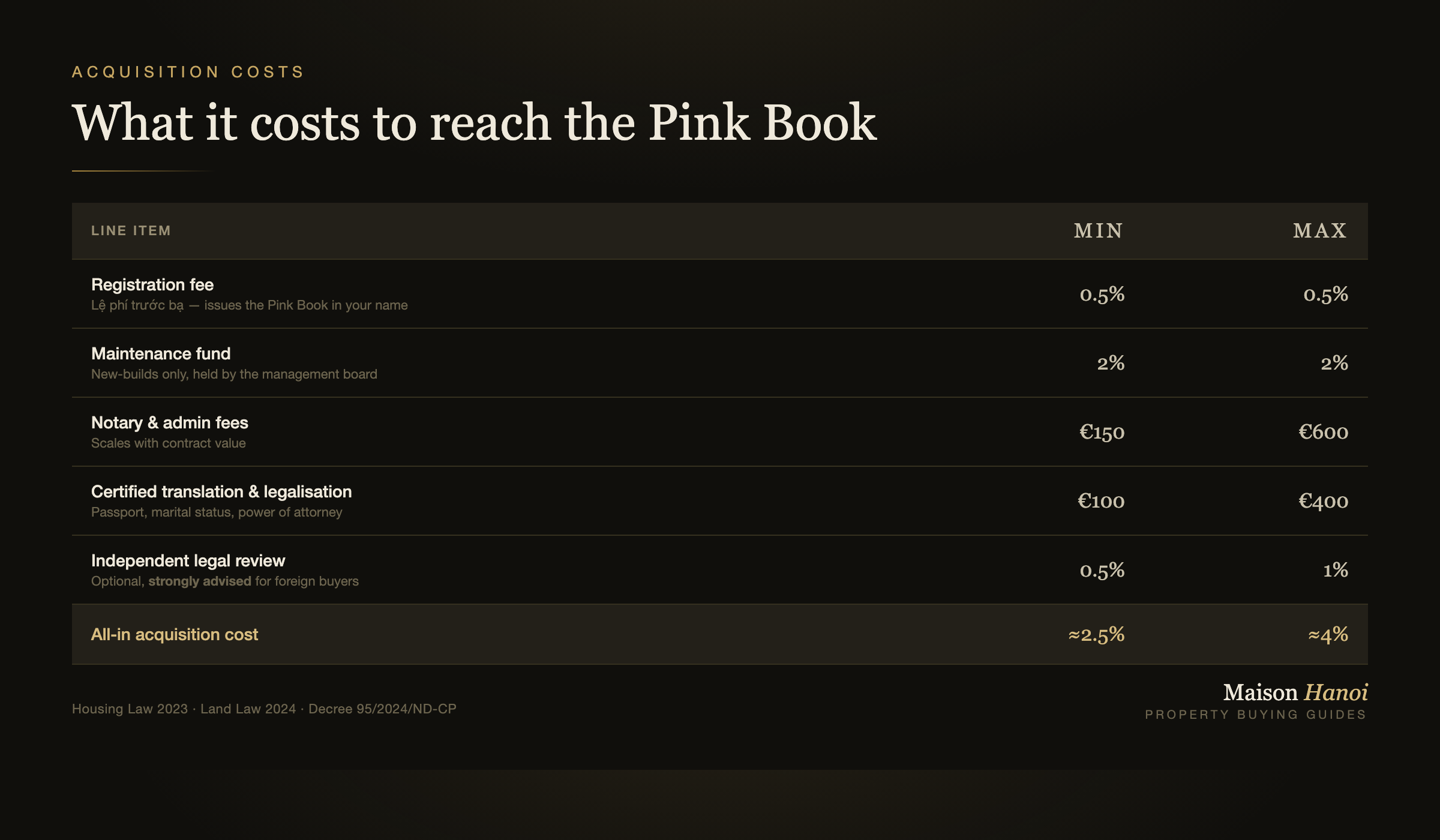
Erwerbskosten: Was es braucht, um das Pink Book zu erhalten
Beispielrechnung für eine Neubauwohnung zu €530.000 — aktueller Median in Tây Hồ (Live-Daten).
| — | Min | Max | Base |
|---|---|---|---|
| Registrierungsgebühr (lệ phí trước bạ)Stellt das Pink Book (sổ hồng) aus | 0.5% | 0.5% | % des deklarierten WertsKäufer, bei Eigentumsregistrierung |
| Instandhaltungs- / RücklagefondsVerwaltet vom Verwaltungsrat des Gebäudes | 2% | 2% | % des WertsKäufer, nur Neubauten |
| Notar- & VerwaltungsgebührenOrientiert sich am Vertragswert | €150 | €600 | einmaligKäufer, bei Vertragsunterzeichnung |
| Beglaubigte Übersetzung & LegalisierungReisepass, Familienstand, Vollmacht | €100 | €400 | einmaligKäufer, wenn Dokumente ausländisch sind |
| Unabhängige rechtliche PrüfungFür ausländische Käufer dringend empfohlen | 0.5% | 1% | % des Preises (optional)Käufer, vor Vertragsunterzeichnung |
| Total | ≈2.5% | ≈4% |
Beispiel — Neubauwohnung zu €530.000 (Median Tây Hồ)
- Registrierungsgebühr 0,5 %
- €2,650 (~73M VND)
- Instandhaltungsfonds 2 %
- €10,600 (~292M VND)
- Notar & Verwaltung
- €400 (~11M VND)
- Beglaubigte Übersetzung
- €250 (~7M VND)
- Σ
- ≈ €13.900 (~382M VND) · ca. 2,6 % des Preises
Housing Law 2023 · Land Law 2024 · Decree 95/2024/ND-CP
Grundsteuer über den Besitzzyklus hinweg
| Phase | Abgabe | Satz | Wer zahlt |
|---|---|---|---|
| Beim Kauf | Registrierungsgebühr (lệ phí trước bạ) | 0,5 % des Werts | Käufer |
| Beim Kauf (Neubau) | Instandhaltungs- / Rücklagefonds | 2 % des Werts | Käufer |
| Beim Kauf (Neubau) | MwSt, im Entwicklerpreis enthalten | Siehe MwSt-Leitfaden | Käufer |
| Während des Besitzes | Jährliche Grundsteuer | Keine | — |
| Bei Vermietung | MwSt + Einkommensteuer | 5 % + 5 % der Bruttomiete | Vermieter |
| Beim Wiederverkauf | Einkommensteuer (Übertragung) | 2 % des Verkaufspreises | Verkäufer |
Häufig gestellte Fragen
Was ist die Immobilienübertragungssteuer in Vietnam?
Die Übertragungssteuer ist eine 2 % persönliche Einkommensteuer auf den Verkaufspreis, fällig bei jedem Eigentümerwechsel. Rechtlich trägt sie der Verkäufer, aber welche Partei sie tatsächlich zahlt, ist verhandelbar und sollte schriftlich im Vertrag festgelegt werden. Es gibt keinen Ausländerzuschlag.
Erhebt Vietnam jährliche Grundsteuern?
Nein. Vietnam kennt keine wiederkehrende jährliche Steuer auf Wohneigentum wie taxe foncière oder Grundsteuer. Die einzige laufende Abgabe ist eine vernachlässigbare nicht-landwirtschaftliche Flächennutzungssteuer, die üblicherweise auf Gebäudeebene beglichen wird. Ihre tatsächlichen laufenden Kosten sind private Verwaltungs- und Servicegebühren, keine öffentliche Grundsteuer.
Gibt es in Vietnam eine Grundsteuer für Ausländer?
Ausländer werden auf derselben Basis wie vietnamesische Eigentümer besteuert — es gibt keine jährliche Grundsteuer und keine spezielle Abgabe nur für Ausländer. Sie zahlen die 0,5 % Registrierungsgebühr beim Erwerb, 5 % + 5 % auf Mieteinnahmen und 2 % beim Wiederverkauf. Das Eigentum läuft über eine erneuerbare 50-jährige Laufzeit.
Wie viel Steuern zahlen Ausländer in Vietnam auf Immobilien?
Auf die Immobilie selbst entfallen etwa 2,5–4 % des Kaufpreises (Registrierung, Instandhaltungsfonds und Verwaltung), 10 % auf die Bruttomiete bei Vermietung (5 % MwSt plus 5 % Einkommensteuer) und 2 % des Verkaufspreises beim Verkauf. Die Einkommensteuer auf andere Einkünfte hängt von Ihrem Aufenthaltsstatus ab.
Welche Steuern zahlt man in Vietnam?
Für Eigentümer sind die Immobiliensteuern die 0,5 % Registrierungsgebühr, der 2 % Neubau-Instandhaltungsfonds, 5 % + 5 % auf Mieteinnahmen und 2 % beim Wiederverkauf. Allgemein erhebt Vietnam MwSt sowie persönliche und Körperschaftssteuern; ob Ihr weltweites Einkommen hier steuerpflichtig ist, hängt von Ihrem Steuerwohnsitz ab.
Hat die USA ein Doppelbesteuerungsabkommen mit Vietnam?
Die USA und Vietnam unterzeichneten 2015 ein Doppelbesteuerungsabkommen, das jedoch noch nicht in Kraft getreten ist, sodass derzeit keine Steuererleichterungen für US-Steuerzahler gelten. Die meisten EU-Länder — darunter Frankreich, Deutschland, Italien und Spanien — haben gültige Abkommen mit Vietnam. Klären Sie Ihre Situation mit einem Steuerberater.
Ist Vietnam für Expats steuerfrei?
Nein. Immobiliengeschäfte und Mieteinnahmen werden unabhängig von der Staatsangehörigkeit besteuert, und wenn Sie vietnamesischer Steuerresident werden — grob 183 Tage oder mehr im Jahr — kann Ihr Einkommen hier steuerpflichtig sein. Vietnam ist vergleichsweise niedrig besteuert bei Immobilien, aber nicht steuerfrei.
Quellen
- Wohnungsgesetz 2023 (Gesetz Nr. 27/2023/QH15) — legt den rechtlichen Rahmen für die Ausstellung des Pink Book, Eigentumsrechte und die Gebührenbasis für ausländische Käufer fest.
- Landgesetz 2024 (Gesetz Nr. 31/2024/QH15) — regelt die Flächennutzungsrechte und die Grundlage der Registrierungsgebühr (lệ phí trước bạ).
- Verordnung 95/2024/ND-CP — Durchführungsverordnung mit Details zu den Bestimmungen des Wohnungsgesetzes 2023 zu Gebühren und Abgaben (zum Zeitpunkt der Veröffentlichung keine verifizierte offizielle englische URL; hier nur als Referenz zitiert).
Modellieren Sie Ihre Gesamtkosten mit einem Berater in Hanoi
Nennen Sie uns den Bezirk, Immobilientyp und Ihr Budget, und unser Beratungsteam erstellt Ihnen innerhalb von 24 Stunden eine detaillierte Schätzung der Steuern, Gebühren und Übertragungskosten — unverbindlich und ohne Weitervermittlung.