
El papeleo explicado
IVA (propiedad en Vietnam): qué es, por qué importa, cómo obtenerlo
¿Qué es el IVA y se aplica cuando compro una propiedad en Hanoi?
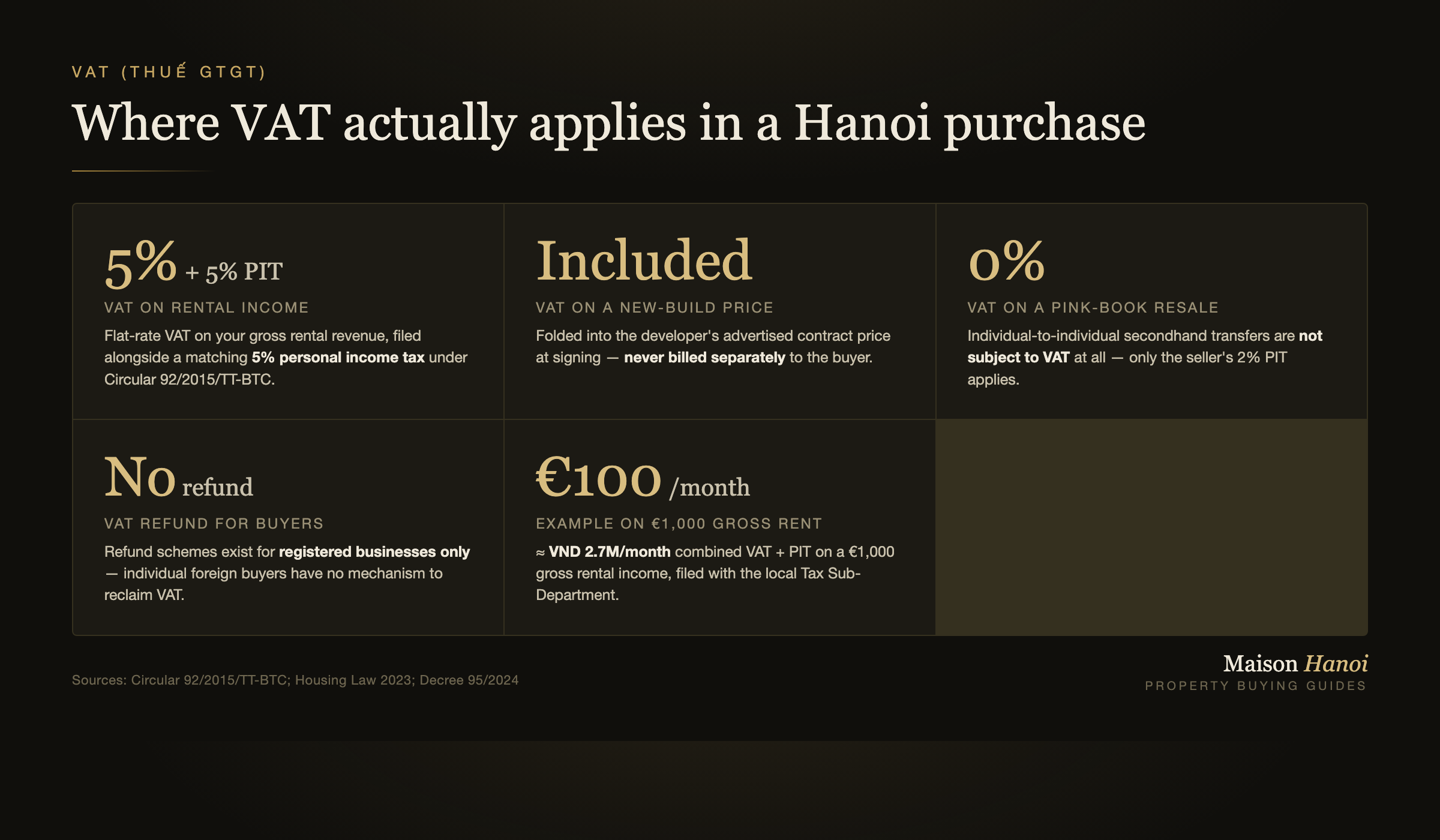
El IVA (thuế GTGT) rara vez aparece como un cargo separado cuando compras en Hanoi: está incluido en el precio anunciado por el desarrollador para una unidad de nueva construcción, y las reventas individuales no están sujetas a él en absoluto. Se vuelve directamente relevante una vez que alquilas la propiedad, cuando se aplica un IVA fijo del 5% más un impuesto sobre la renta personal (PIT) del 5% sobre los ingresos brutos por alquiler.
IVA de un vistazo
Documento- Nombre vietnamita
- Thuế giá trị gia tăng (GTGT)
- Denominado en la guía en inglés simplemente como VAT
- Se aplica a
- El precio de venta del desarrollador para unidades de nueva construcción, y cualquier ingreso por alquiler que obtengas de tu propiedad
- Las compras de individuo a individuo (segunda mano, libro rosa) no están sujetas al IVA en absoluto
- Administrado por
- La autoridad fiscal de Vietnam (Departamento de Impuestos, Ministerio de Finanzas), a través de tu Subdepartamento Fiscal local
- Declarado bajo el mismo código fiscal (MST) usado para tu tarifa de registro
- Tasa que se aplica a los propietarios
- IVA fijo del 5% sobre los ingresos brutos por alquiler
- Combinado con un impuesto sobre la renta personal del 5% en la misma declaración — Circular 92/2015/TT-BTC
- En la compra
- Incluido en el precio del contrato para unidades de nueva construcción — no facturado por separado al comprador
- No se emite factura de IVA en una transferencia de libro rosa de segunda mano
- Frecuencia de presentación
- Por contrato de arrendamiento, o anualmente bajo la opción de declaración anual
- Presentado por ti o tu contador en el Subdepartamento Fiscal local
- Requerido para
- Cualquier propietario extranjero que arriende una propiedad en Hanoi
- No requerido si mantienes la unidad solo para uso personal y nunca la alquilas
¿Qué es el IVA y cuándo importa para tu compra en Hanoi?
El impuesto al valor agregado — thuế giá trị gia tăng, usualmente abreviado GTGT — es el impuesto indirecto nacional de Vietnam sobre el suministro de bienes y servicios, administrado por el Departamento de Impuestos bajo el Ministerio de Finanzas. Para una compra directa de un desarrollador autorizado, el IVA no aparece como un ítem que pagas aparte del precio: es un impuesto empresarial que el desarrollador ya debe sobre la venta y que se incluye en la cifra del contrato anunciada. Los derechos de uso de la tierra en sí están fuera de la base del IVA, y una transferencia de segunda mano entre dos individuos — una reventa de libro rosa — no está sujeta al IVA en absoluto; solo se aplica el impuesto sobre la renta personal del vendedor (2% del precio de venta).
El IVA se convierte en algo con lo que tratas directamente una vez que decides arrendar tu propiedad en Hanoi. Los ingresos por alquiler obtenidos por un propietario individual, residente o no, están bajo el régimen de tasa fija establecido en la Circular 92/2015/TT-BTC: un 5% combinado de IVA y 5% de impuesto sobre la renta personal sobre tus ingresos brutos por alquiler, declarado ya sea por contrato de arrendamiento o anualmente. Esta es la tasa de IVA que realmente afecta a un propietario extranjero en la práctica — no una tasa cobrada al firmar, sino una que se activa el día que comienzas a cobrar renta.
Costos relacionados con el IVA para un propietario extranjero
El IVA en una compra de nueva construcción está incluido en el precio del desarrollador y no se factura por separado. Las filas a continuación cubren el costo recurrente que se aplica directamente a los propietarios: IVA e impuesto sobre la renta personal (PIT) sobre los ingresos por alquiler.
| — | Min | Max | Base |
|---|---|---|---|
| IVA sobre ingresos por alquilerRégimen de tasa fija para individuos — Circular 92/2015/TT-BTC | 5% | 5% | % de los ingresos brutos por alquilerPropietario-arrendador, por contrato de arrendamiento o declaración anual |
| PIT sobre ingresos por alquilerDeclarado en la misma declaración que el IVA por alquiler | 5% | 5% | % de los ingresos brutos por alquilerPropietario-arrendador, presentado junto con el IVA |
| IVA sobre el precio de compra de nueva construcciónNo facturado por separado al comprador; no se aplica a reventas de libro rosa de segunda mano | Included | Included | incluido en el precio del contratoDesarrollador, al firmar |
| Exención por debajo del umbral mínimo de ingresosNo se debe IVA ni PIT si tus ingresos brutos anuales por alquiler están por debajo del umbral mínimo — consulta a tu contador para la cifra actual | — | — | establecido por la circular fiscal vigentePropietario-arrendador |
| Total | 5% + 5% | 5% + 5% |
Ejemplo ilustrativo: €1,000/mes de ingresos brutos por alquiler
- IVA (5% del alquiler bruto)
- €50/month · ≈ VND 1.35M
- PIT (5% del alquiler bruto)
- €50/month · ≈ VND 1.35M
- Σ
- ≈ €100/mes · ≈ VND 2.7M, presentado en el Subdepartamento Fiscal local
Circular 92/2015/TT-BTC · 2023 Housing Law and Decree 95/2024/ND-CP
Cómo se aplica el IVA a lo largo de tu compra y propiedad
⏱ Continuo — recurrente una vez que alquilas la propiedad
No "solicitas" el IVA como lo harías con un certificado — ya está incluido en el precio del desarrollador, o se activa automáticamente una vez que comienzas a ganar ingresos por alquiler. Los pasos a continuación muestran dónde el IVA afecta tu expediente, para que sepas qué revisar y cuándo, incluso si un abogado o contador maneja las presentaciones en tu nombre.
- 1
Verifica si el IVA está incluido en tu precio de nueva construcción
⏱ Antes de firmar
Pide a tu abogado o al equipo de ventas del desarrollador que confirme por escrito que el precio anunciado incluye IVA, y solicita la factura de IVA (hóa đơn GTGT) emitida al firmar. Las compras de libro rosa de segunda mano no llevan factura de IVA — solo las ventas de nueva construcción de un desarrollador autorizado.
DocumentsContrato de compraventa · Factura de IVA (hóa đơn GTGT) — solo nueva construcción
⚠Un contrato que establece el precio de forma ambigua puede dejar que el IVA — y el fondo de mantenimiento del 2% — se añadan encima de la cifra principal.
- 2
Decide si vas a alquilar la propiedad
⏱ En cualquier momento después de la entrega
El IVA solo se convierte en una obligación recurrente para ti personalmente una vez que arriendes la unidad. Si planeas mantenerla solo para uso personal, no se requiere ninguna presentación adicional de IVA más allá de la factura original del desarrollador.
- 3
Registra tu actividad de alquiler en el Subdepartamento Fiscal local
⏱ Antes o al inicio del arrendamiento
Una vez que firmas un contrato de arrendamiento, tu contador o administrador de la propiedad registra la actividad de alquiler y confirma que tu código fiscal (MST) está vinculado a ella. Esta es la misma presentación que establece tu obligación de IVA y PIT sobre la renta.
DocumentsPasaporte · Contrato de arrendamiento · Número de identificación fiscal (MST)
⚠Alquilar una unidad sin declararlo es una fuente común de sanciones una vez que la autoridad fiscal cruza la información de los registros de arrendamiento.
- 4
Presenta y paga el IVA y PIT sobre tus ingresos por alquiler
⏱ Por contrato de arrendamiento, o anualmente◈ 5% IVA + 5% PIT de los ingresos brutos por alquiler
Declara los ingresos brutos por alquiler y paga el 5% combinado de IVA y 5% de PIT, ya sea por contrato de arrendamiento o mediante la opción de declaración anual, según lo que tu contador recomiende para tu situación.
DocumentsContrato de arrendamiento · Formulario de declaración fiscal
⚠Los propietarios extranjeros sin un código fiscal vietnamita registrado no pueden presentar — resuelve esto antes de que venza tu primer pago de renta.
Preguntas frecuentes
¿Qué es el IVA en Vietnam?
El IVA (thuế giá trị gia tăng, GTGT) es el impuesto indirecto nacional de Vietnam sobre el suministro de bienes y servicios, administrado por el Departamento de Impuestos. Para la propiedad específicamente, los derechos de uso de la tierra están fuera de la base del IVA — en la práctica aparece incluido en el precio de nueva construcción de un desarrollador, o como la tasa fija del 5% aplicada a los ingresos por alquiler que obtienes como propietario.
¿Existe un IVA del 10% en Vietnam?
Vietnam aplica IVA a nivel nacional a la mayoría de bienes y servicios, pero los derechos de uso de la tierra están excluidos de la base del IVA y una reventa de libro rosa de segunda mano no está sujeta al IVA en absoluto — solo se aplica el impuesto sobre la renta personal del vendedor del 2%. La tasa que afecta directamente a un propietario extranjero es el IVA fijo del 5% sobre los ingresos por alquiler, combinado con un PIT del 5% correspondiente.
¿Cómo obtengo mi reembolso de IVA?
Los compradores extranjeros individuales generalmente no tienen un mecanismo para reclamar el IVA incluido en el precio del desarrollador — los esquemas de reembolso en Vietnam están diseñados para empresas registradas que reclaman el IVA de insumos, no para compradores privados. Si crees que se cobró IVA incorrectamente, por ejemplo en una transferencia de libro rosa de segunda mano, consulta con tu abogado o contador en lugar de con el desarrollador.
¿Cuál es la tasa actual de IVA sobre ingresos por alquiler en Vietnam?
Se aplica un IVA fijo del 5% sobre los ingresos brutos por alquiler de un propietario individual, presentado junto con un impuesto sobre la renta personal del 5% bajo la Circular 92/2015/TT-BTC. Este régimen de tasa fija para arrendadores individuales no ha cambiado para 2026.
¿Recibo una factura de IVA cuando compro una propiedad en Hanoi?
Si compras nueva a un desarrollador autorizado, sí — deberías recibir una factura de IVA (hóa đơn GTGT) que refleje el impuesto ya incluido en el precio. Una compra de segunda mano entre individuos, transferida por libro rosa, no genera factura de IVA en absoluto.
¿Puedo calcular mi obligación de IVA yo mismo?
Para ingresos por alquiler la aritmética es simple — 5% de IVA más 5% de PIT sobre tu renta bruta, sin deducciones bajo el régimen de tasa fija — pero confirmar si tus ingresos están bajo algún umbral mínimo de exención y presentarlo correctamente es mejor que lo maneje un contador autorizado vietnamita.
¿Se aplica IVA al comprar un apartamento de reventa (segunda mano)?
No. Las transferencias de libro rosa de individuo a individuo no están sujetas a IVA. En cambio, el vendedor paga un impuesto sobre la renta personal del 2% del precio de venta, y el comprador paga la tarifa estándar de registro del 0.5%.
Fuentes
- Ley de Vivienda 2023 (27/2023/QH15)
- Ley de Tierras 2024 (31/2024/QH15)
- Circular 92/2015/TT-BTC — régimen de IVA y impuesto sobre la renta personal a tasa fija para arrendadores individuales
- Decreto 95/2024/ND-CP — decreto de implementación que detalla la aplicación de la Ley de Vivienda 2023
- Departamento General de Impuestos (Tổng cục Thuế) — autoridad fiscal de Vietnam
¿No estás seguro si el IVA ya está incluido en tu contrato?
Envíanos tu Contrato de Compraventa, o tu contrato de arrendamiento si planeas alquilar la unidad. Nuestro equipo asesor en Hanoi verifica la situación del IVA y te dirige a un contador autorizado si necesitas uno — sin obligación, y nunca como sustituto de tu propio asesoramiento legal.