
Entender el inmobiliario vietnamita
Ley de propiedad en Vietnam para extranjeros: derechos de propiedad, cuotas y el Libro Rosa
¿Puede un extranjero poseer legalmente propiedad en Vietnam?
Cómo funciona la propiedad inmobiliaria en Vietnam
Vietnam no reconoce la propiedad privada de la tierra. Según la Constitución y la Ley de Tierras 2024 (Luật Đất đai), toda la tierra es propiedad del Estado en nombre del pueblo, y lo que los compradores adquieren realmente es un conjunto de derechos de uso de la tierra en lugar del suelo en sí. Estos derechos se registran en el certificado que todo comprador desea tener — el Sổ hồng, o Libro Rosa, formalmente el Certificado de Derechos de Uso de la Tierra y Propiedad Adjunta a la Tierra.
Para un comprador extranjero, la distinción no es académica. Usted puede poseer el edificio — un apartamento o una casa con terreno dentro de un desarrollo comercial aprobado — y recibe un Libro Rosa a su nombre. Lo que no puede poseer es la tierra subyacente. Por eso el marco se entiende mejor como una forma de arrendamiento en lugar de la propiedad plena a la que están acostumbrados los compradores europeos en sus países. La Ley de Vivienda 2023 (Luật Nhà ở) es la norma que abre la propiedad residencial a individuos y organizaciones extranjeras, mientras que el Decreto 95/2024 establece los detalles de implementación.
El plazo asociado a la propiedad extranjera es de 50 años, renovable una vez. Los ciudadanos vietnamitas, en cambio, tienen derechos de uso residencial de la tierra de forma estable y prácticamente indefinida. La diferencia entre estas dos posiciones — un plazo fijo renovable para extranjeros, seguridad a largo plazo para locales — es lo más importante que debe entender antes de comprometerse, y está en el corazón de nuestra guía completa para comprar propiedad en Vietnam como extranjero.
La propiedad se prueba con el Libro Rosa, no con el contrato de venta. Hasta que el certificado se emita a su nombre en la oficina de tierras del distrito, usted tiene un reclamo contractual, no un título registrado. Debido a que las categorías de activos que un extranjero puede poseer son limitadas, conviene entender los tipos de propiedad disponibles para compradores extranjeros antes de seleccionar algo — las reglas difieren notablemente entre apartamentos, casas con terreno y tierra sin desarrollar.
Lo que los extranjeros pueden comprar — y cómo se comparan los Việt Kiều y los locales
Los extranjeros pueden comprar edificios residenciales dentro de proyectos de vivienda comercial aprobados para propiedad extranjera. En la práctica, eso significa apartamentos en desarrollos de condominios elegibles y, menos comúnmente, casas con terreno — villas y casas adosadas — dentro de esos mismos proyectos aprobados. No puede comprar tierra agrícola, no puede comprar un terreno en el mercado abierto para construir, y no puede comprar nada en una zona militar o de seguridad nacional designada. El proyecto debe ser elegible: aprobado por la autoridad local, con cuota extranjera aún disponible.
Dos cuotas regulan cuánto de un proyecto puede pasar a manos extranjeras. En cualquier edificio de apartamentos, los extranjeros pueden poseer como máximo el 30% de las unidades. En un barrio dado (phường, aproximadamente 10,000 residentes), los extranjeros pueden poseer como máximo 250 casas con terreno. Una vez alcanzado cualquiera de estos límites, no es posible realizar más compras extranjeras en ese edificio o barrio — comprar más allá del límite no puede producir un Libro Rosa válido, por lo que la verificación de la cuota es un paso innegociable, detallado en nuestro proceso de compra paso a paso.
La situación cambia para los Việt Kiều — vietnamitas en el extranjero. Desde la Ley de Tierras 2024, los nacionales vietnamitas residentes en el extranjero y personas de origen vietnamita tienen derechos cercanos a los de los ciudadanos residentes: en general, pueden poseer derechos de uso de la tierra a largo plazo y no están sujetos a las cuotas del 30% y 250. Alguien con pasaporte vietnamita es tratado como ciudadano para estos fines. La tabla a continuación resume dónde divergen las tres posiciones.
| Derecho | Extranjero | Việt Kiều (vietnamita en el extranjero) | Ciudadano vietnamita |
|---|---|---|---|
| Poseer derechos de uso de la tierra | No — solo edificios | Sí, casi ciudadano (Ley de Tierras 2024) | Sí |
| Comprar apartamentos en proyectos aprobados | Sí, dentro de la cuota | Sí | Sí |
| Plazo de propiedad | 50 años, renovable una vez | Plazo largo / estable | Plazo largo / estable |
| Sujeto a cuotas del 30% / 250 | Sí | No | No |
| Comprar fuera de proyectos comerciales aprobados | No | En general sí | Sí |
Hay un límite más que aplica a todos: la Ley de Negocios Inmobiliarios regula quién puede vender y bajo qué condiciones, por lo que un desarrollador confiable, un título limpio y una cuota disponible importan tanto como el precio cuando evalúa una unidad específica.
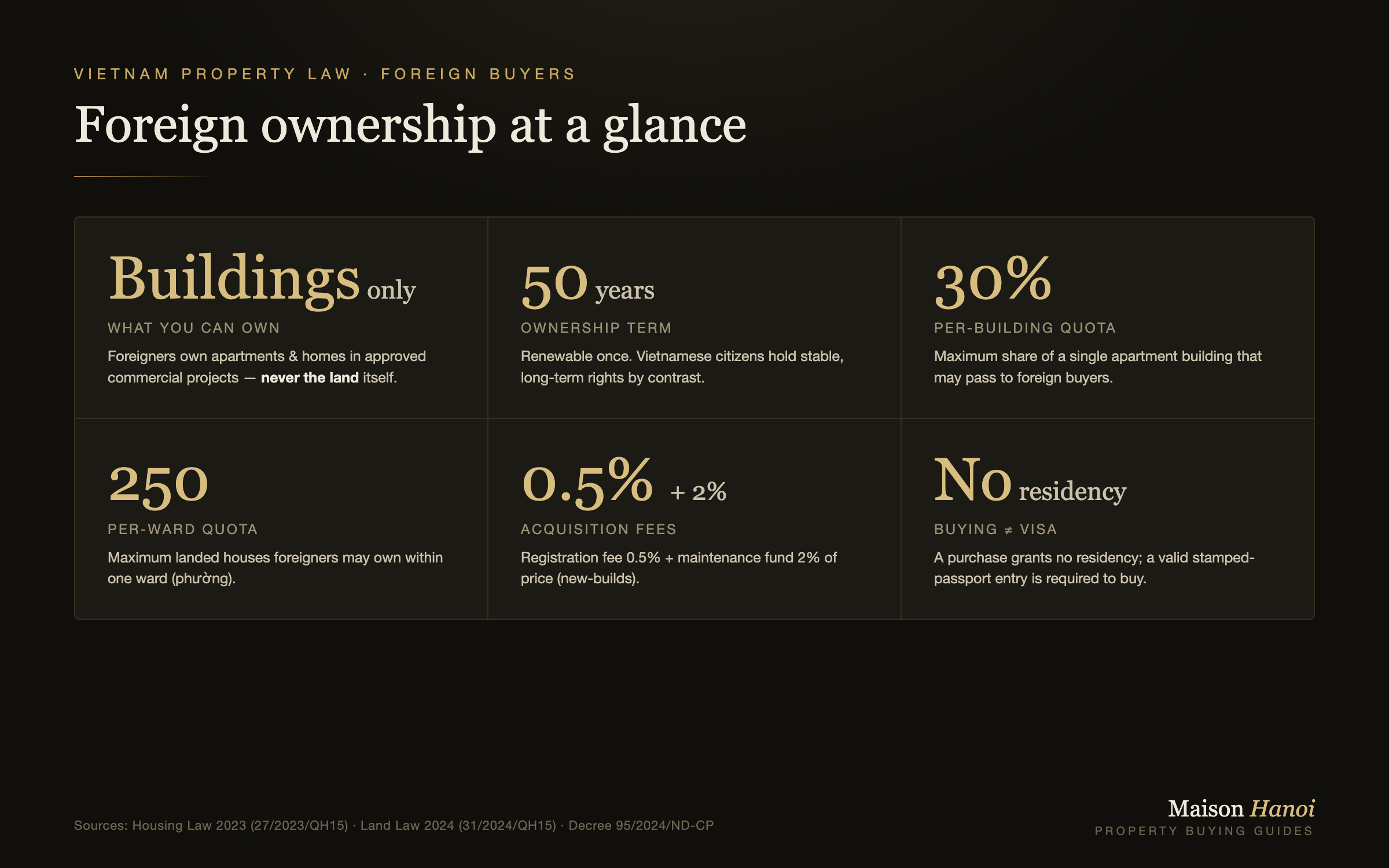
Reglas de propiedad extranjera en Vietnam de un vistazo
Referencia legal- Propiedad de la tierra
- No disponible para nadie
- El Estado posee la tierra; los compradores adquieren derechos de uso (Ley de Tierras 2024)
- Lo que los extranjeros pueden comprar
- Edificios en proyectos comerciales aprobados
- No tierra; nada en zonas militares o de seguridad (Ley de Vivienda 2023)
- Plazo de propiedad extranjera
- 50 años, renovable una vez
- Ley de Vivienda 2023
- Cuota por edificio
- Máximo 30% de los apartamentos de un edificio
- Ley de Vivienda 2023
- Cuota por barrio
- Máximo 250 casas con terreno por barrio
- Barrio ≈ 10,000 residentes
- Tasa de registro
- 0.5% del precio
- Comprador, al registrar el Libro Rosa
- Residencia por compra
- Ninguna
- Se requiere entrada legal con pasaporte sellado para comprar
- Hipoteca local
- Generalmente no disponible para no residentes
- Marco del Decreto 95/2024
Ejemplar: el Libro Rosa (Sổ hồng)
Cómo se asegura la propiedad extranjera, paso a paso
⏱ 3–6 meses
La propiedad legal se construye en una secuencia fija. Cada paso protege al anterior, y el Libro Rosa al final es lo que convierte un contrato en título registrado.
- 1
Confirme su elegibilidad para comprar
⏱ Antes de comenzar
Debe haber entrado a Vietnam legalmente — un pasaporte con sello de entrada válido es el requisito básico. Confirme que el objetivo no esté en una zona militar o de seguridad nacional.
⚠Poseer propiedad no otorga residencia ni visa — gestione su estatus migratorio por separado.
→ law firms - 2
Verifique la aprobación del proyecto y la cuota extranjera
⏱ 1–2 semanas
Compruebe que el desarrollo sea un proyecto de vivienda comercial aprobado y que su cuota extranjera del 30% por edificio (o 250 por barrio) aún tenga espacio. Este es el paso que la mayoría de los compradores omite y luego lamenta.
DocumentsDecisión de aprobación del proyecto · Confirmación de cuota extranjera por parte del desarrollador
⚠Comprar una vez que la cuota extranjera del 30% de un edificio esté llena no puede producir un título válido.
- 3
Firme el Contrato de Compraventa notariado
⏱ 2–4 semanas
El SPA debe ser bilingüe y notariado, con el precio expresado en đồng vietnamita tanto en palabras como en cifras, y un calendario de pagos claro vinculado a hitos de construcción o entrega.
DocumentsSPA bilingüe · Pasaporte
→ law firms - 4
Registre y reciba su Libro Rosa
⏱ 1–3 meses◈ 0.5% de registro + 2% fondo de mantenimiento
La oficina de tierras del distrito registra los derechos de uso de la tierra y la propiedad del edificio a su nombre y emite el Sổ hồng por el plazo de 50 años. Solo ahora posee título registrado.
DocumentsSổ hồng (Libro Rosa)
Preguntas frecuentes
¿Puede un extranjero comprar propiedad en Hanoi?
Sí. Los extranjeros pueden comprar apartamentos — y algunas casas con terreno — dentro de proyectos comerciales aprobados para propiedad extranjera, dentro de la cuota del 30% por edificio. La propiedad es por un plazo de 50 años, renovable una vez. No puede comprar la tierra ni propiedades en zonas militares o de seguridad.
¿Puede un ciudadano estadounidense o americano comprar propiedad en Vietnam?
Sí. La Ley de Vivienda 2023 aplica las mismas reglas a todos los extranjeros sin importar la nacionalidad — incluidos los estadounidenses. Debe haber entrado legalmente a Vietnam con pasaporte sellado. No hay restricción separada para ciudadanos estadounidenses ni requisito de residencia para completar la compra.
¿Comprar propiedad en Vietnam otorga residencia?
No. Poseer propiedad en Vietnam no confiere derecho a residencia, visa ni camino a la ciudadanía. Compra como visitante con un sello de entrada válido, y gestiona su estatus migratorio por separado a través de los canales ordinarios de visa turística, de negocios o de trabajo.
¿Pueden los extranjeros poseer tierra en Vietnam?
No — y tampoco los ciudadanos vietnamitas en el sentido occidental. Toda la tierra es propiedad del Estado; los compradores adquieren derechos de uso de la tierra registrados en el Libro Rosa. Los extranjeros poseen el edificio y esos derechos de uso por 50 años, renovable una vez, pero nunca el suelo.
¿Puede una persona francesa con raíces vietnamitas comprar tierra y construir una casa?
Las personas de origen vietnamita — Việt Kiều — tienen derechos cercanos a los de los ciudadanos residentes desde la Ley de Tierras 2024, y no están sujetas a las cuotas para extranjeros. Alguien con pasaporte vietnamita es tratado como ciudadano. Un abogado autorizado debe confirmar su estatus exacto antes de actuar.
¿Cómo funciona realmente la propiedad inmobiliaria en Vietnam?
La propiedad se evidencia con el Sổ hồng (Libro Rosa), el Certificado de Derechos de Uso de la Tierra y Propiedad. Registra quién posee el edificio y los derechos de uso de la tierra, el propósito y el plazo. Hasta que se emita a su nombre en la oficina de tierras del distrito, usted tiene un contrato, no título.
¿Qué sucede después de que termina el plazo de propiedad de 50 años?
El plazo de propiedad extranjera es renovable una vez, extendiendo sus derechos más allá de los 50 años iniciales sujeto a la ley vigente en la renovación. También es común vender a un ciudadano vietnamita antes de ese momento. Cubrimos la mecánica en nuestra guía sobre el límite de propiedad de 50 años y su renovación.
Fuentes
- Ley de Vivienda 2023 (Luật Nhà ở, No. 27/2023/QH15), en vigor desde 01/08/2024 — texto oficial en inglés, thuvienphapluat.vn
- Ley de Tierras 2024 (Luật Đất đai, No. 31/2024/QH15), en vigor desde 01/08/2024 — texto oficial en inglés, thuvienphapluat.vn
- Ley de Negocios Inmobiliarios 2023 (Luật Kinh doanh Bất động sản, No. 29/2023/QH15), en vigor desde 01/08/2024 — texto oficial en inglés, thuvienphapluat.vn
- Decreto 95/2024/ND-CP — decreto de implementación que detalla la propiedad extranjera bajo la Ley de Vivienda 2023 (citada para referencia; no hay URL oficial verificada en inglés al momento de escribir).
Haga revisar su elegibilidad y el título antes de comprometerse
Nuestro escritorio asesor en Hanoi verifica cuotas extranjeras, aprobaciones de proyectos y estado del Libro Rosa para compradores potenciales. Solicite una segunda opinión independiente y responderemos en 24 horas.