
Vietnamesische Immobilien verstehen
Hypotheken für Ausländer in Vietnam: was wirklich möglich ist
Können Ausländer in Vietnam eine Hypothek bekommen?
Warum eine lokale Hypothek für Ausländer schwer zu bekommen ist
Aktualisiert Juli 2026. Wenn Sie an Hypotheken in Ihrem Heimatland gewöhnt sind, erfordert der vietnamesische Markt einige Anpassungen. Lokale Banken vergeben Kredite auf vietnamesische Immobilien hauptsächlich an Einwohner mit inländischem Einkommen und Kreditgeschichte – und nicht ansässige ausländische Käufer liegen außerhalb dieser Komfortzone. Dies ist eine Frage der Bankpolitik und praktischen Kreditvergabe, kein gesetzliches Verbot: Nichts im vietnamesischen Immobilienrecht verbietet Ausländern, lokal Kredite aufzunehmen, aber nur wenige Banken haben Produkte, englischsprachige Prozesse oder Risikobereitschaft entwickelt, um Sie als Nichtansässigen zu bedienen.
Was die Kreditvergabe erschwert
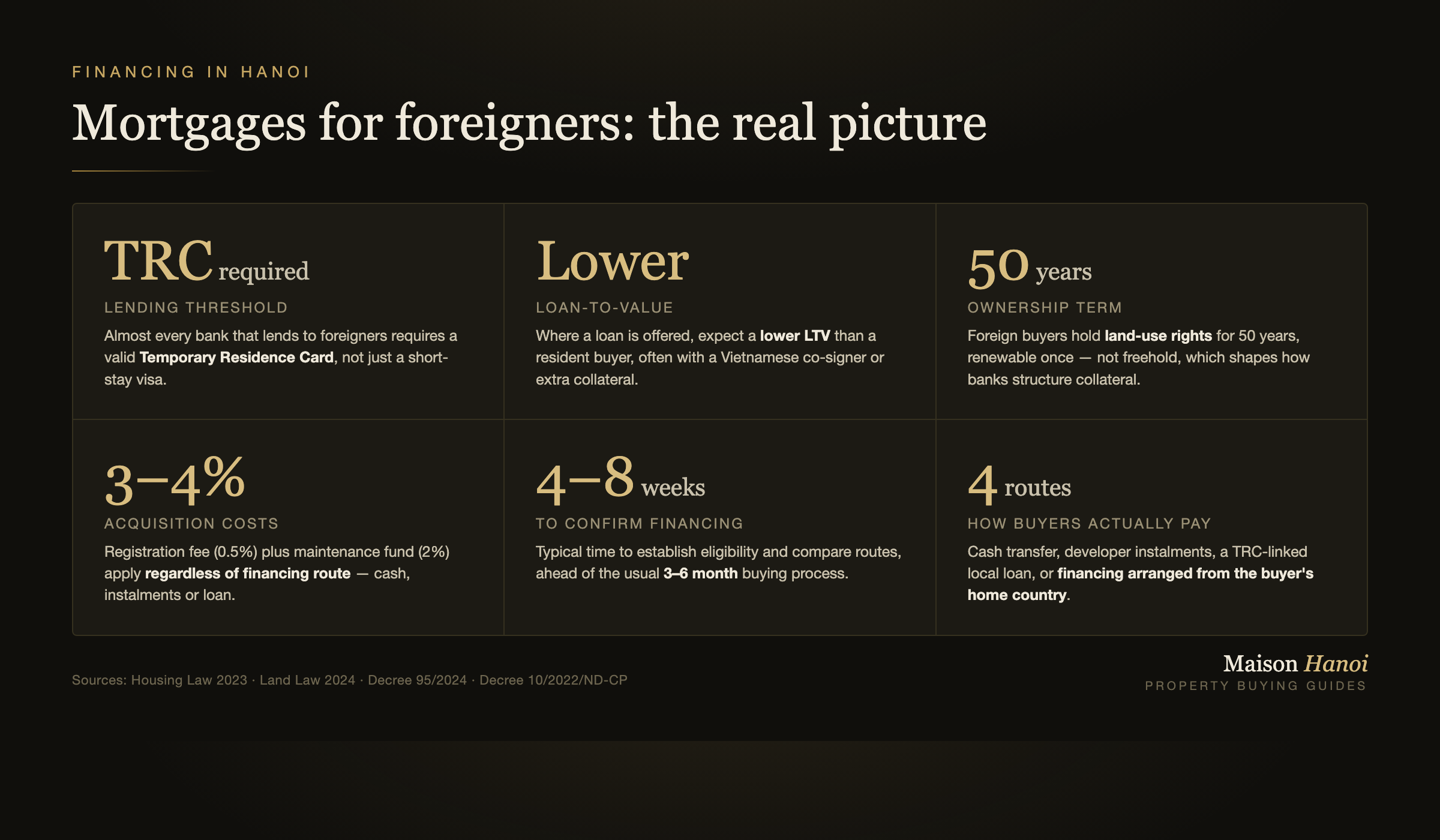
Drei Schwierigkeiten treten immer wieder auf. Erstens wollen die meisten Kreditgeber lokale Einkünfte sehen oder zumindest eine Aufenthaltsgenehmigung (TRC) statt eines Kurzzeitvisums – einen Nachweis eines gewissen Status im Land über einen Urlaubsaufenthalt hinaus. Zweitens ist die Sicherheit selbst ungewöhnlich für eine ausländerorientierte Kreditakte: Als nicht-vietnamesischer Eigentümer halten Sie Nutzungsrechte am Grundstück für eine Laufzeit von 50 Jahren, einmal verlängerbar, statt eines Eigentumsrechts, und Banken strukturieren die Sicherheiten um diese Nutzungsdauer anders. Drittens überträgt sich eine grenzüberschreitende Kreditgeschichte selten – eine starke Hypothekenhistorie in Paris, Mailand oder London hat wenig Gewicht bei einem Darlehensbearbeiter in Hanoi, der diese nicht verifizieren kann.
Das Ergebnis ist ein Markt, in dem eine kleine Anzahl von Banken – meist größere inländische und internationale Namen mit einem speziellen Expat- oder Private-Banking-Schalter – einen ausländischen Antragsteller in Betracht ziehen, fast immer mit einem niedrigeren Beleihungsauslauf als bei einem ansässigen Kreditnehmer und häufig mit der Forderung nach einem vietnamesischen Mitunterzeichner, Bürgen oder zusätzlicher Sicherheit. Unser Leitfaden zum rechtlichen Rahmen für ausländischen Besitz behandelt die dahinterstehenden Eigentumsregeln.
Die Finanzierungswege, die tatsächlich funktionieren
In der Praxis verlassen sich die meisten ausländischen Käufer in Hanoi überhaupt nicht auf eine vietnamesische Hypothek. Vier Wege decken die große Mehrheit der Käufe ab.
Bargeld, über das Bankensystem transferiert
Der häufigste Weg: Gelder werden aus dem Ausland auf ein vietnamesisches Bankkonto überwiesen, das mit der Transaktion verbunden ist, und dann gemäß dem Kaufvertrag bezahlt. Dies ist auch der administrativ sauberste Weg – eine dokumentierte Überweisung ist das, was Ihnen später erlaubt, Erlöse bei einem Wiederverkauf zurückzuführen. Unser Leitfaden zur Finanzierung und Bezahlung Ihres Kaufs erklärt die Mechanik der Geldbewegung nach Vietnam.
Der gestaffelte Zahlungsplan des Entwicklers
Bei Käufen auf dem Papier und Neubauten bieten Entwickler routinemäßig einen Zahlungsplan an, der über Bauabschnitte verteilt ist, statt einer einzigen Summe. Es handelt sich nicht um einen Bankkredit – in der Regel werden keine Zinsen berechnet, wenn Sie den Plan einhalten – aber es funktioniert als private Finanzierung und erleichtert die Liquiditätsbelastung eines großen Kaufs. Das Verpassen einer Rate kann vertragliche Strafen nach sich ziehen, lesen Sie den Zahlungsplan also genauso sorgfältig wie die Preisklausel.
Eine lokale Hypothek, wenn Sie eine TRC besitzen
Eine Handvoll Banken, vor allem solche mit einem Expat- oder Ausländerkundenschalter, vergeben Kredite an Ausländer mit gültiger Aufenthaltsgenehmigung, die typischerweise an Beschäftigung, Investition oder Ehe in Vietnam gebunden ist. Die Konditionen variieren von Bank zu Bank erheblich und ändern sich ohne Vorankündigung, behandeln Sie daher jedes unverbindliche Angebot als genau das, bis es schriftlich bestätigt ist; wenden Sie sich über unser Bankenverzeichnis für ausländische Käufer an mehrere Kreditgeber.
Finanzierung aus Ihrem Heimatland arrangieren
Viele Käufer nutzen stattdessen eine Umschuldung oder Freisetzung von Eigenkapital auf einer Immobilie im Heimatland, einen Privatkredit oder Ersparnisse und transferieren die Erlöse als eine einzige Kapitalbewegung nach Vietnam. Dies umgeht die vietnamesische Kreditprüfung vollständig, obwohl Ihr heimischer Kreditgeber die Transaktion nach eigenen Kriterien bewertet – und auch hier sollte die Überweisung dokumentiert sein, um eine saubere Prüfspur zu gewährleisten. Ein auf grenzüberschreitende Immobilienkäufe erfahrener Makler kann bei der Strukturierung helfen; siehe unsere Hypotheken- und Finanzierungsberater und Kreditvermittler, die mit ausländischen Käufern in Hanoi arbeiten.
Was der Abschluss kostet, egal wie Sie finanzieren
Diese gesetzlichen Sätze gelten unabhängig vom Finanzierungsweg; das Rechenbeispiel verwendet den Median in Tây Hồ (Live-Daten) als anschauliches Beispiel.
| — | Min | Max | Base |
|---|---|---|---|
| Registrierungsgebühr (lệ phí trước bạ) | 0.5% | 0.5% | % des deklarierten PreisesKäufer, bei Eintragung ins Grundbuch |
| Instandhaltungs- / RücklagefondsEinmalige Zahlung in den Betriebskostenvoranschlag des Gebäudes | 2% | 2% | % des PreisesKäufer, Neubauten |
| Notar & beglaubigte Übersetzung≈ VND 4–16 Millionen; variiert mit Vertragswert | €150 | €600 | einmaligKäufer, bei Vertragsunterzeichnung |
| Unabhängige Rechts- / FinanzierungsberatungUnabhängiger Anwalt oder Finanzierungs-/Hypothekenberater | 0.5% | 1% | % des Preises (optional)Käufer, für ausländische Käufer dringend empfohlen |
| Bankgebühr für Arrangement / BewertungVarriert von Bank zu Bank – vor Antrag bestätigen | Set by lender | Set by lender | einmalig, nur bei Nutzung eines KreditsKäufer, bei lokaler Finanzierung |
| Total | ≈3% | ≈4% |
Beispiel: eine Wohnung für €530.000 (Median Tây Hồ)
- Registrierungsgebühr 0,5 %
- €2,650 · ≈ VND 72M
- Instandhaltungsfonds 2 %
- €10,600 · ≈ VND 286M
- Notar & Übersetzung
- €400 · ≈ VND 11M
- Σ
- €13.650 · ≈ VND 369M
Decree 10/2022/ND-CP (registration fee) · Housing Law 2023 (maintenance fund) · Land Law 2024 · Decree 95/2024
Die Wahl Ihres Finanzierungsweges
⏱ 4–8 Wochen zur Finanzierungsbestätigung, vor dem üblichen 3–6-monatigen Kaufprozess
- 1
Klärung Ihres Aufenthalts- und Visastatus
⏱ Sofort◈ Keine direkten Kosten
Prüfen Sie, ob Sie eine Aufenthaltsgenehmigung (TRC) oder nur ein Kurzzeitvisum besitzen. Die TRC ist die praktische Schwelle, die fast jede Bank anstelle einer inländischen Kreditgeschichte verwendet – dies ist das Erste, was Sie vor Kontaktaufnahme mit einem Kreditgeber bestätigen sollten.
DocumentsReisepass · Aktuelles Visum oder TRC
⚠Die Annahme, dass ein Langzeitvisum ausreicht – die meisten Banken, die an Ausländer verleihen, verlangen eine gültige TRC, nicht nur ein Einreisevisum.
- 2
Kontaktieren Sie Banken mit einem Ausländer-Kreditprogramm
⏱ 2–4 Wochen◈ Antrags- / Bewertungsgebühren variieren je nach Bank
Kontaktieren Sie mehrere Banken parallel und fordern Sie deren Zulassungskriterien und einen unverbindlichen Beleihungsauslauf schriftlich an. Programme und Schwellenwerte variieren je nach Bank und ändern sich ohne Vorankündigung, daher sollte eine mündliche Schätzung einer Filiale niemals als Angebot betrachtet werden.
DocumentsReisepass & TRC · Einkommensnachweis · Kontoauszüge · Reservierungsvereinbarung oder Immobiliendossier
⚠Ein mündliches „Ja“ als Genehmigung zu behandeln – lassen Sie sich Zulassung und Beleihungsauslauf schriftlich bestätigen, bevor Sie eine Reservierungsgebühr zahlen.
- 3
Vergleichen Sie mit dem gestaffelten Zahlungsplan des Entwicklers
⏱ Läuft parallel zu Ihrer Reservierung◈ Keine Arrangementgebühr; Plan ist vertraglich
Bei einer Off-Plan-Einheit wägen Sie einen lokalen Kredit gegen den eigenen Ratenplan des Entwicklers ab, der an Bauabschnitte gebunden ist. Es fallen keine Bankgebühren an, aber der Plan ist vertraglich festgelegt und verpasste Raten können Strafen auslösen.
DocumentsReservierungsvereinbarung · Zahlungsplan
⚠Das Verpassen einer Frist für eine Teilzahlung kann vertragliche Strafen oder den Verlust früherer Raten zur Folge haben.
- 4
Finanzierung aus Ihrem Heimatland arrangieren, falls nötig
⏱ Läuft parallel, bevor Sie Gelder transferieren◈ Varriert je nach Kreditgeber im Heimatland
Wenn lokale Kredite für Sie nicht offenstehen, nutzen Sie Ersparnisse, eine Umschuldung oder Eigenkapitalfreisetzung auf einer Immobilie im Heimatland oder einen Privatkredit und transferieren Sie die Erlöse als eine einzige, klar dokumentierte Kapitalbewegung nach Vietnam.
DocumentsDarlehensvertrag, falls verwendet · Nachweis der Herkunft der Mittel
⚠Das Überweisen von Geldern ohne saubere Dokumentation erschwert einen späteren Wiederverkauf oder die Rückführung der Erlöse.
- 5
Gelder transferieren und den Kauf abschließen
⏱ 1–4 Wochen pro Rate◈ Registrierung 0,5 % + Instandhaltungsfonds 2 % (siehe Tabelle oben)
Bewegen Sie Gelder über das vietnamesische Banksystem auf das im Kaufvertrag benannte Konto, gemäß dem Zahlungsplan, und bewahren Sie jeden Überweisungsbeleg zusammen mit Ihren Eintragungs- und Steuerunterlagen auf.
DocumentsBanküberweisungsbelege · Kaufvertrag · Steuer- und Gebührenbelege
⚠Barzahlung ohne Banknachweis – siehe unseren Leitfaden zum schrittweisen Kaufprozess.
Hypotheken- und Finanzierungsberater für ausländische Käufer
Odin Mortgage
Courtage de prets immobiliers pour expatriés australiens et investisseurs etrangers (40+ preteurs, revenus en devises)
Hong Kong · EN
Atlas Wealth Group
Gestion de patrimoine et courtage de prets immobiliers (mortgages) pour expatriés australiens
Gold Coast · EN
Specialist Mortgage
Courtage de prets immobiliers pour expatriés australiens depuis 1995 (solutions domestiques et offshore)
Singapore · EN
Australian Expat Home Loans
Courtiers specialistes des prets immobiliers pour expatriés australiens (Singapour, Hong Kong, Dubai)
Singapore · EN
Banken mit Programmen für ausländische Käufer in Hanoi

Standard Chartered Bank (Vietnam) Ltd
3.4 / 5Banque internationale; Priority Banking & wealth management (The Good Life), Priority Private; comptes, cartes, prêts/hypothèques, FX; clientèle expatriée/HNW.
Hanoi · EN, VN

Woori Bank Vietnam Ltd
3.3 / 5Filiale coréenne (Woori Bank); détail, dépôts, cartes, prêts non garantis et hypothécaires, assurance, remises; offres dédiées aux expatriés coréens (dont garantie études en Corée).
Hanoi · EN, VN

HSBC Bank (Vietnam) Ltd
4.5 / 51re banque étrangère incorporée au Vietnam; banque internationale pour expatriés; HSBC Premier (wealth), comptes, prêts immobiliers/home equity, cartes, remises & Global Transfers, investissement/assurance.
Ho Chi Minh City · EN, VN

Shinhan Bank Vietnam Ltd
3.9 / 51re banque étrangère de détail au Vietnam (groupe coréen Shinhan); comptes, prêts (dont hypothécaires), cartes, remises; forte clientèle expatriée coréenne.
Ho Chi Minh City · EN, VN
Häufig gestellte Fragen
Können Ausländer in Vietnam eine Hypothek bekommen?
Selten, und nur von einer kleinen Anzahl von Banken – meist an Inhaber einer gültigen Aufenthaltsgenehmigung, mit einem niedrigeren Beleihungsauslauf als bei einem ansässigen Kreditnehmer. Die meisten ausländischen Käufer zahlen stattdessen bar, nutzen den gestaffelten Zahlungsplan eines Entwicklers oder finanzieren den Kauf aus ihrem Heimatland.
Wie viel kostet eine Hypothek in Vietnam?
Zinsen, Gebühren und Beleihungsausläufe werden individuell von jeder Bank festgelegt und ändern sich häufig, daher gibt es keinen einheitlichen Wert für den gesamten Markt. Unabhängig vom Finanzierungsweg sollten Sie separat mit etwa 3–4 % Erwerbskosten – Registrierungsgebühr, Instandhaltungsfonds und Notar – rechnen, wie in der obigen Tabelle dargestellt.
Kann ein US-Bürger in Vietnam eine Hypothek bekommen?
Die Staatsangehörigkeit ist normalerweise nicht der entscheidende Faktor – der Aufenthaltsstatus ist es. Ein US-Bürger mit gültiger Aufenthaltsgenehmigung kann sich an dieselbe kleine Anzahl von Banken wenden, die an ausländische Einwohner verleihen; mit einem Kurzzeitvisum ist ein lokaler Kredit sehr unwahrscheinlich.
Brauche ich eine Aufenthaltsgenehmigung (TRC), um einen Kredit zu bekommen?
In der Praxis ja, bei fast jeder Bank, die überhaupt an Ausländer vergibt. Eine TRC – typischerweise durch Beschäftigung, Investition oder Ehe in Vietnam erworben – ist die Schwelle, die die meisten Kreditgeber anstelle einer inländischen Kreditgeschichte verwenden. Ein Touristen- oder Geschäftsvisum allein schließt fast alle lokalen Finanzierungen aus.
Kann ich eine Finanzierung aus meinem Heimatland nutzen, um in Vietnam zu kaufen?
Ja – so finanzieren die meisten ausländischen Käufer einen Kauf in Hanoi. Eine Umschuldung oder Eigenkapitalfreisetzung auf einer Immobilie im Heimatland, ein Privatkredit oder Ersparnisse können als eine einzige Kapitalbewegung transferiert werden. Dokumentieren Sie die Überweisung klar: Diese Aufzeichnung ermöglicht später die Rückführung der Erlöse.
Wenn ich keine Hypothek bekomme, wie zahlen die meisten ausländischen Käufer?
Überwiegend bar, aus dem Ausland über das vietnamesische Bankensystem transferiert oder über den gestaffelten Zahlungsplan des Entwicklers, der an Bauabschnitte gebunden ist. Keiner dieser Wege erfordert einen lokalen Kredit, und beide unterliegen derselben 0,5 % Registrierungsgebühr und 2 % Instandhaltungsfonds, die jeder Käufer zahlt. Siehe unseren Schritt-für-Schritt-Kaufprozess.
Quellen
- Wohnungsgesetz 2023 (Gesetz Nr. 27/2023/QH15) – regelt den Instandhaltungsfonds und den Rahmen für Wohneigentum, auf den in diesem Leitfaden Bezug genommen wird.
- Landgesetz 2024 (Gesetz Nr. 31/2024/QH15) – regelt die Nutzungsrechte am Land und die 50-jährige Eigentumsdauer für ausländische Käufer.
- Verordnung 10/2022/ND-CP – legt die 0,5 % Registrierungsgebühr fest (kein verifizierter offizieller englischer Text verfügbar; nur als Referenz zitiert).
- Verordnung 95/2024/ND-CP – Durchführungsverordnung zum Wohnungsgesetz 2023 (kein verifizierter offizieller englischer Text verfügbar; nur als Referenz zitiert).
- Allgemeine Steuerbehörde (Tổng cục Thuế) – Finanzbehörde für immobilienbezogene Steuern und Gebühren.
- Einwanderungsbehörde (Cục Quản lý xuất nhập cảnh) – zuständig für die Ausstellung von Aufenthaltsgenehmigungen und Visaregeln.
Verschaffen Sie sich eine unabhängige Einschätzung Ihrer Finanzierungsoptionen
Teilen Sie unserem Hanoi-Schalter Ihren Aufenthaltsstatus, Ihr Budget und Ihren Zeitplan mit, und wir zeigen Ihnen innerhalb von 24 Stunden, welche Finanzierungswege für Sie realistisch offenstehen – Bargeldtransfer, gestaffelte Zahlungen oder ein lokaler Kredit – ohne Verpflichtung und ohne Weitervermittlung.