
Comprendre l’immobilier vietnamien
Transfert de fonds vers le Vietnam pour un achat immobilier
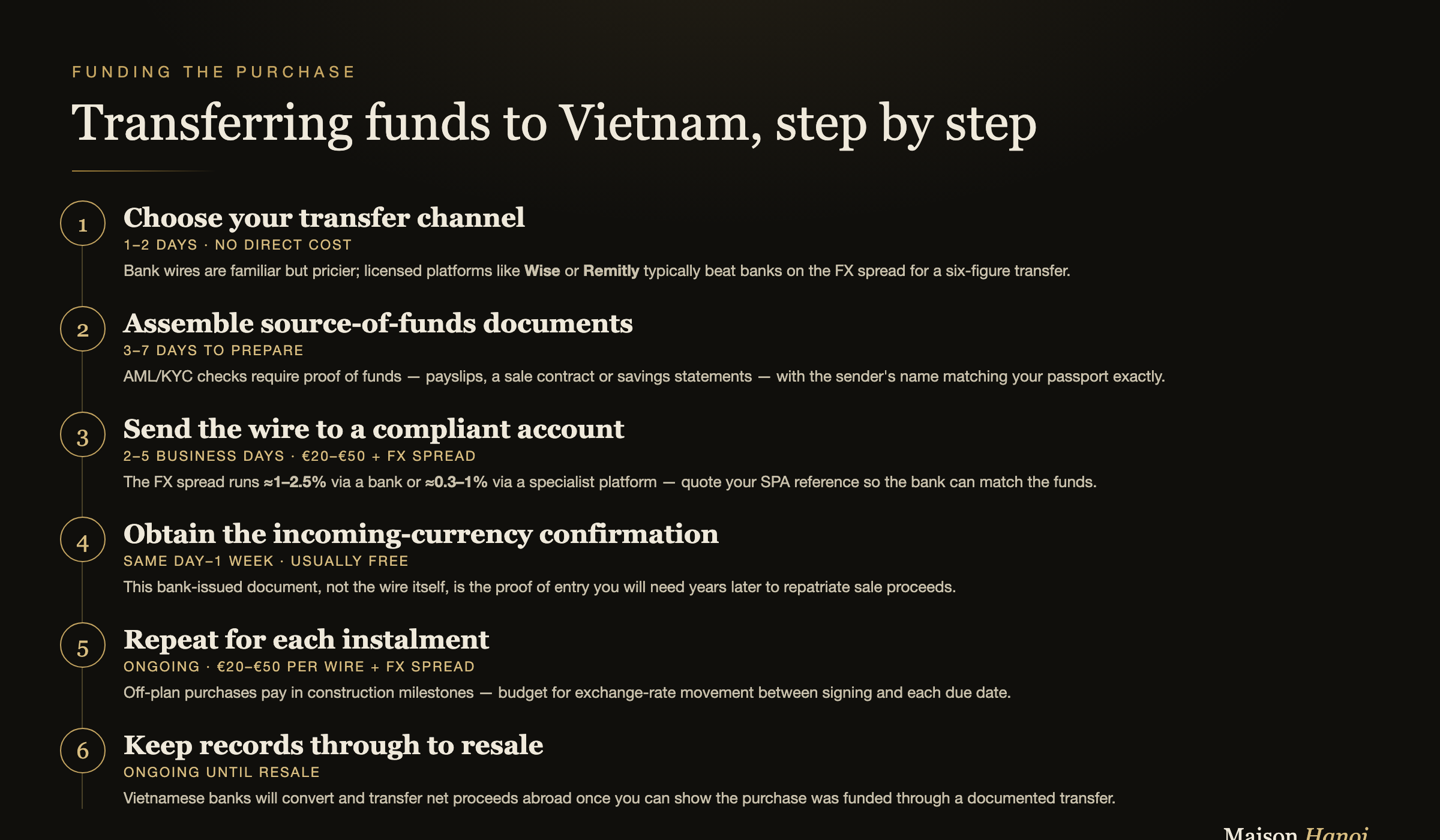
Comment fonctionne le transfert, de la décision au Livre Rose
⏱ 1 à 3 semaines pour le transfert initial ; en cours jusqu'à la revente pour le rapatriement éventuel
Transférer six chiffres au Vietnam est simple une fois que vous suivez la voie conforme. Les étapes ci-dessous vous guident du choix du canal jusqu'à la conservation des documents que vous voudrez avoir des années plus tard, lors de la revente.
- 1
Choisissez votre canal de transfert
⏱ 1 à 2 jours pour décider◈ Pas de coût direct à ce stade
Deux canaux fonctionnent de manière fiable pour un transfert de taille immobilière : un virement bancaire SWIFT depuis votre banque d'origine, ou une plateforme internationale de transfert d'argent agréée telle que Wise ou Remitly. Les banques sont familières et rassurantes mais appliquent généralement une marge de change plus large ; les plateformes spécialisées sont généralement moins chères sur la marge de change pour un transfert à six chiffres, bien que toutes ne versent pas directement en VND à toutes les banques réceptrices — vérifiez cela avant de vous engager. Quel que soit votre choix, confirmez à l'avance que le prestataire peut acheminer les fonds vers une banque vietnamienne et demandez un devis écrit du taux de change et de tous les frais.
DocumentsPasseport · Devis d'au moins deux prestataires
⚠Choisir uniquement sur le taux de change affiché — comparez toujours le montant total reçu après frais et marge, pas le taux annoncé.
- 2
Rassemblez votre documentation sur la provenance des fonds
⏱ 3 à 7 jours pour préparer◈ Pas de coût direct
Étant donné qu'il s'agit d'un transfert transfrontalier de grande valeur, votre banque ou plateforme effectuera des contrôles anti-blanchiment (AML) et connaissance client (KYC) avant de libérer les fonds. Rassemblez des preuves de l'origine de l'argent — fiches de paie, contrat de vente immobilière, relevés d'épargne ou déclaration de don — et assurez-vous que le nom de l'expéditeur correspond exactement à celui de votre passeport. Les transferts effectués via un tiers, comme un parent ou une société, attirent une surveillance accrue et des retards ; dans la mesure du possible, envoyez depuis un compte déjà à votre nom.
DocumentsRelevés bancaires · Justificatif de revenus ou de vente d'actifs · Déclaration de don ou de prêt si les fonds ne sont pas entièrement les vôtres
⚠Un décalage entre le nom de l'expéditeur et celui de l'acheteur sur le Contrat de Vente est la cause la plus fréquente de blocage d'un transfert.
- 3
Envoyez le virement vers un compte récepteur conforme
⏱ 2 à 5 jours ouvrables◈ Frais de virement de 20 à 50 €, plus la marge de change (≈1–2,5 % via une banque, ≈0,3–1 % via une plateforme spécialisée)
Les fonds doivent arriver sur un compte bancaire vietnamien — soit un compte non-résident ouvert à votre nom, soit, plus couramment pour un achat en développement, le compte du promoteur ou le compte séquestre mentionné dans votre Contrat de Vente. Indiquez la référence du contrat ou de la facture dans les détails du paiement du virement afin que la banque réceptrice puisse l'associer à votre contrat. Un virement SWIFT standard est généralement compensé en deux à cinq jours ouvrables ; les plateformes spécialisées peuvent être plus rapides pour les paires de devises prises en charge. Consultez notre guide sur le financement d'un achat et le paiement en plusieurs fois pour voir comment cela s'intègre à votre calendrier de paiement.
DocumentsRéférence SWIFT / numéro du Contrat de Vente · Détails du compte récepteur du promoteur ou de votre banque
⚠Omettre la référence de paiement — les transferts entrants non appariés peuvent être bloqués en attente d'enquête, parfois pendant des semaines.
- 4
Obtenez la confirmation de réception de devises étrangères
⏱ Du jour même à une semaine après réception◈ Généralement gratuit ; certaines banques facturent une petite commission administrative
Une fois les fonds crédités, demandez à la banque vietnamienne réceptrice sa confirmation officielle du transfert de devises étrangères entrant. Ce document — et non le virement lui-même — est votre preuve que l'argent est entré dans le pays via le système bancaire, et c'est ce que la banque vietnamienne vous demandera plus tard si vous souhaitez convertir et rapatrier le produit de la vente après une revente. Classez-le avec votre Contrat de Vente et conservez une copie numérique ; ne comptez pas sur le promoteur ou l'agent pour le conserver à votre place.
DocumentsConfirmation de transfert de devises entrantes (émise par la banque)
⚠Perdre ce document est la raison la plus fréquente pour laquelle les propriétaires étrangers ont des difficultés à rapatrier les fonds des années plus tard — conservez une copie papier et une copie numérique.
- 5
Planifiez les versements suivants selon votre calendrier de paiement
⏱ En cours, sur plusieurs mois ou années pour un achat sur plan◈ 20 à 50 € par virement supplémentaire, plus la marge de change à chaque fois
Les achats sur plan sont généralement payés en plusieurs versements liés aux étapes de construction plutôt qu'en un seul transfert. Répétez le processus de virement pour chaque versement, et prévoyez les fluctuations du taux de change entre la signature de votre Contrat de Vente et chaque échéance — une variation de quelques pourcents sur plusieurs années de construction est courante. Certains acheteurs demandent à leur banque ou plateforme des contrats à terme ou des blocages de taux pour gérer cela ; demandez avant d'en avoir besoin, pas après qu'un paiement soit déjà dû.
DocumentsCalendrier de paiement mis à jour par le promoteur
⚠Manquer une échéance de versement parce qu'un transfert a pris plus de temps que prévu — envoyez toujours les fonds plusieurs jours ouvrables avant la date d'échéance.
- 6
Conservez les documents pour un rapatriement éventuel
⏱ En cours jusqu'à la revente◈ Pas de coût maintenant ; frais de conversion et de transfert sortant applicables au moment du transfert
Lorsque vous vendrez finalement, les banques vietnamiennes vous permettront généralement de convertir et de transférer à l'étranger le produit net de la vente — à condition que vous puissiez prouver que les fonds ont été légalement acquis, ou que l'achat initial a été financé par un transfert légal et documenté. Conservez votre Contrat de Vente, chaque confirmation de transfert entrant, et vos déclarations fiscales pendant toute la durée de votre propriété ; un expert-comptable ou un avocat à Hanoi pourra préparer le dossier de rapatriement le moment venu.
DocumentsContrat de Vente · Toutes les confirmations de transferts entrants · Déclarations fiscales
⚠Supposer que le rapatriement est automatique — cela dépend entièrement de la traçabilité que vous avez construite au départ.
Coût pour faire arriver les fonds au Vietnam
Exemple chiffré sur un appartement à 530 000 € — le médian actuel de Tây Hồ (données en direct) — combinant les coûts de transfert avec les taux légaux dus à l'enregistrement.
| — | Min | Max | Base |
|---|---|---|---|
| Frais de virement international (banque SWIFT)Les banques correspondantes/intermédiaires peuvent prélever des « frais de levage » supplémentaires en cours de route | €20 | €50 | ponctuel, par transfertAcheteur, facturé par la banque émettrice |
| Marge de conversion FX — virement bancaireRarement divulguée comme poste séparé | 1% | 2.5% | % du montant convertiAcheteur, incluse dans le taux de change |
| Marge de conversion FX — plateforme agrééeex. Wise, Remitly — généralement moins cher qu'un virement bancaire à cette échelle | 0.3% | 1% | % du montant convertiAcheteur |
| Frais de banque réceptrice (Vietnam)Déduit avant que les fonds ne soient crédités sur le compte récepteur | €10 | €25 | ponctuelAcheteur, déduit à l'arrivée |
| Frais d'enregistrement (Livre Rose)Taux légal — Loi sur le logement 2023 / Décret 95/2024/ND-CP | 0.5% | 0.5% | % de la valeur déclaréeAcheteur, à l'enregistrement du titre |
| Fonds de maintenance / de réserveDétenu par le conseil de gestion de l'immeuble | 2% | 2% | % de la valeurAcheteur, uniquement pour les constructions neuves |
| Total | ≈3% | ≈5% |
Exemple — appartement à 530 000 € (médian Tây Hồ), transféré via une plateforme agréée
- Marge FX (plateforme, ≈0,5 %)
- €2,650 (~VND 73M)
- Frais de banque réceptrice
- €20 (~VND 550,000)
- Frais d'enregistrement 0,5 %
- €2,650 (~VND 73M)
- Fonds de maintenance 2 %
- €10,600 (~VND 292M)
- Σ
- ≈ 15 920 € (~438 M VND) · environ 3 % du prix
Housing Law 2023 · Decree 95/2024/ND-CP
Questions fréquemment posées
Les étrangers peuvent-ils transférer de l'argent au Vietnam pour acheter un bien immobilier ?
Oui. Il n'y a aucune restriction pour les étrangers apportant des fonds au Vietnam pour acheter un bien immobilier, à condition que le transfert passe par le système bancaire — un virement SWIFT ou une plateforme agréée vers un compte vietnamien conforme. Ce qui importe, c'est que le transfert soit documenté : conservez la confirmation bancaire de la devise reçue, car cela soutient à la fois votre achat et, plus tard, le rapatriement des produits de la vente.
Que se passe-t-il si vous transférez plus de 10 000 $ ?
Un achat immobilier implique généralement des transferts bien supérieurs à ce montant, ce qui est normal. Le seuil de 10 000 $ est un seuil de déclaration utilisé par plusieurs pays — y compris les États-Unis — dans le cadre des règles anti-blanchiment : les banques signalent ou déclarent les transferts au-dessus de ce seuil, elles ne les bloquent pas. Attendez-vous à ce que votre banque émettrice ou plateforme demande une documentation sur la provenance des fonds une fois les montants atteints.
Peut-on transférer de l'argent du Vietnam vers les États-Unis ?
Oui, en principe — le Vietnam autorise les transferts sortants de revenus légalement acquis et de produits de vente documentés via le système bancaire. En pratique, cela dépend de la capacité à prouver l'origine des fonds, ce qui est beaucoup plus facile lorsque l'argent de l'achat initial est entré au Vietnam via un transfert documenté dès le départ. Voir si Remitly peut envoyer de l'argent du Vietnam vers les États-Unis pour une voie pratique.
Est-il facile de transférer de l'argent hors du Vietnam ?
C'est faisable mais pas instantané : les banques vietnamiennes appliquent des contrôles de conformité sur les transferts sortants, et vous devrez généralement justifier la provenance des fonds — un contrat de vente, des documents de dividendes ou de salaire, ou la confirmation du transfert entrant original. Les acheteurs qui ont tenu des dossiers propres dès le départ trouvent généralement le processus simple ; ceux qui ont payé en espèces ou par des canaux non documentés souvent non.
Quels documents dois-je fournir pour transférer de l'argent au Vietnam pour un achat immobilier ?
Préparez-vous à fournir votre passeport, une preuve de la provenance des fonds (épargne, salaire ou contrat de vente), et les coordonnées du compte récepteur du promoteur ou de votre banque vietnamienne, avec la référence de votre Contrat de Vente. Conservez ensuite la confirmation de la banque réceptrice attestant la réception de devises étrangères — elle devient une partie permanente de votre dossier d'achat.
Puis-je utiliser Wise ou Remitly pour envoyer de l'argent au Vietnam ?
Oui — les plateformes agréées telles que Wise, qui peut envoyer de l'argent depuis le Vietnam, et ses équivalents à l'étranger sont couramment utilisées par les acheteurs étrangers en complément des virements bancaires traditionnels, et sont souvent moins chères sur la marge de change pour un transfert important. Vérifiez que la plateforme verse en VND sur des comptes bancaires vietnamiens et supporte la taille de transfert dont vous avez besoin avant de compter sur elle pour un achat immobilier.
Y a-t-il une taxe de transfert immobilier au Vietnam que je devrais inclure dans le montant du transfert ?
En tant qu'acheteur, prévoyez les frais d'enregistrement de 0,5 % et, pour les constructions neuves, le fonds de maintenance de 2 %, en plus du prix. La taxe de transfert de revente de 2 % est légalement à la charge du vendeur, pas quelque chose que vous payez à l'achat. Consultez notre guide sur ce que couvre la taxe de transfert immobilier au Vietnam pour les étrangers en détail.
Sources
- Loi sur le logement 2023 (Loi n° 27/2023/QH15) — base légale pour les frais d'enregistrement de 0,5 % dus à l'enregistrement du titre.
- Décret 95/2024/ND-CP — décret d'application détaillant les taux des frais d'enregistrement et du fonds de maintenance cités dans ce guide (pas de texte officiel en anglais actuellement disponible).
Planifiez votre transfert avec un conseiller basé à Hanoi
Indiquez-nous le montant, votre pays d'origine et votre calendrier de paiement cible, et notre bureau de conseil vous proposera la voie de transfert conforme — prestataire, documentation et calendrier — sous 24 heures, sans engagement ni recommandation sortante.
Comment transférer de l'argent au Vietnam pour acheter un bien immobilier ?