
Capire l’immobiliare vietnamita
Mutui per stranieri in Vietnam: cosa è realmente possibile
Gli stranieri possono ottenere un mutuo in Vietnam?
Perché è difficile ottenere un mutuo locale come straniero
Aggiornato luglio 2026. Se sei abituato a come funzionano i mutui nel tuo paese, il mercato vietnamita richiede un po' di adattamento. Le banche locali prestano contro proprietà vietnamite principalmente a residenti con reddito e storia creditizia domestica — e gli acquirenti stranieri non residenti sono fuori da questa zona di comfort. Si tratta di una questione di politica bancaria e valutazione pratica, non di un divieto legale: nulla nella legge vietnamita sulla proprietà vieta a uno straniero di prendere in prestito localmente, ma poche banche hanno sviluppato prodotti, processi in inglese o appetito per il rischio per servirti come non residente.
Cosa rende più difficile la valutazione
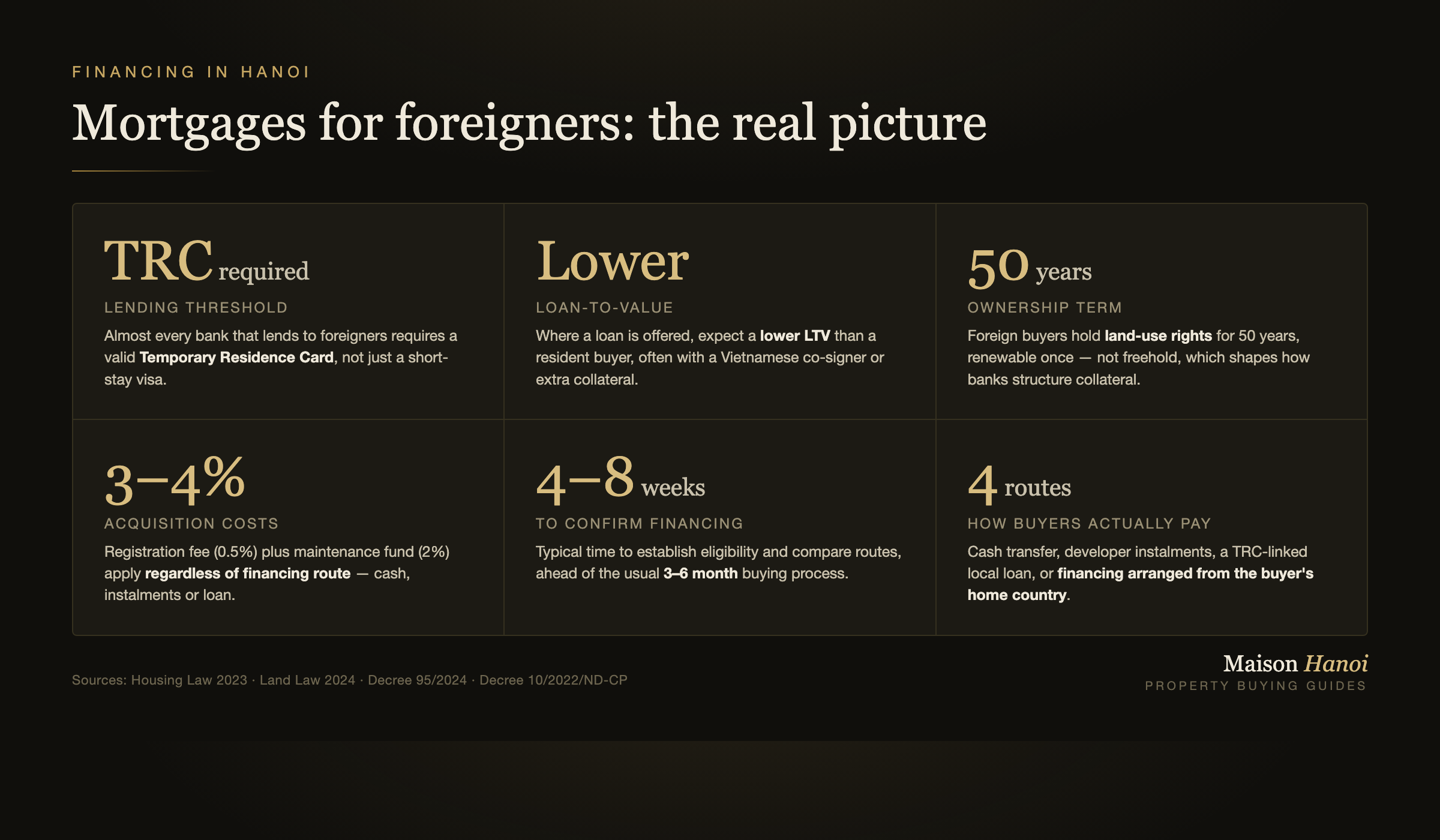
Tre ostacoli ricorrono. Primo, la maggior parte dei finanziatori vuole vedere un reddito locale o, almeno, una Carta di Soggiorno Temporaneo (TRC) piuttosto che un visto a breve termine — prova di una certa posizione nel paese oltre a un timbro di ingresso per vacanze. Secondo, la garanzia stessa è insolita per un prestito rivolto a stranieri: come proprietario non vietnamita detieni diritti d'uso del terreno sull'edificio per un termine di 50 anni, rinnovabile una volta, anziché la piena proprietà, e le banche strutturano la garanzia diversamente in base a questo tipo di possesso. Terzo, la storia creditizia transfrontaliera difficilmente si trasferisce — una solida storia di mutui a Parigi, Milano o Londra ha poco peso per un funzionario di prestito di Hanoi che non ha modo di verificarla.
Il risultato è un mercato in cui un piccolo numero di banche — per lo più grandi nomi nazionali e internazionali con un desk dedicato agli espatriati o private banking — considerano un richiedente straniero, quasi sempre con un rapporto prestito-valore inferiore rispetto a un mutuatario residente, e frequentemente richiedono un co-firmatario vietnamita, un garante o garanzie aggiuntive. La nostra guida al quadro legale per la proprietà straniera copre le regole di proprietà che stanno dietro a questo.
Le modalità di finanziamento che funzionano davvero
In pratica, la maggior parte degli acquirenti stranieri a Hanoi non si affida affatto a un mutuo vietnamita. Quattro modalità coprono la grande maggioranza degli acquisti.
Contanti, trasferiti tramite il sistema bancario
La modalità più comune: i fondi vengono trasferiti dall'estero su un conto bancario vietnamita legato alla transazione, quindi pagati secondo il calendario del Contratto di Compravendita. È anche la modalità più pulita amministrativamente — una traccia documentata del trasferimento è ciò che ti permette in seguito di rimpatriare i proventi quando rivendi. La nostra guida al finanziamento e al pagamento del tuo acquisto spiega la meccanica del trasferimento di denaro in Vietnam.
Il piano di rateizzazione del costruttore
Per acquisti off-plan e di nuova costruzione, i costruttori offrono abitualmente un calendario di pagamento distribuito su tappe di costruzione invece di un'unica somma. Non è un prestito bancario — di solito non si applicano interessi se rispetti il calendario — ma funziona come un finanziamento privato e allevia l'onere di liquidità di un acquisto importante. Mancare una rata può comportare penali contrattuali, quindi leggi il calendario dei pagamenti con la stessa attenzione della clausola sul prezzo.
Un mutuo locale, se possiedi una TRC
Una manciata di banche, in gran parte quelle con un desk per espatriati o clienti stranieri, presta a stranieri che possiedono una valida Carta di Soggiorno Temporaneo, tipicamente legata a impiego, investimento o matrimonio in Vietnam. Le condizioni variano significativamente da banca a banca e cambiano senza preavviso, quindi considera qualsiasi offerta indicativa solo come tale fino a conferma scritta; rivolgiti a più di un prestatore tramite la nostra directory delle banche che servono acquirenti stranieri.
Finanziamento organizzato nel tuo paese d'origine
Molti acquirenti invece ricorrono a una rinegoziazione o rilascio di capitale su una proprietà nel proprio paese, a un prestito personale o a risparmi, e trasferiscono i proventi in Vietnam come un unico movimento di capitale. Questo evita completamente la valutazione vietnamita, anche se il tuo prestatore domestico valuta la transazione secondo i propri criteri — e, ancora, il trasferimento dovrebbe essere documentato per una chiara traccia contabile. Un broker esperto in acquisti immobiliari transfrontalieri può aiutarti a strutturare questo; vedi i nostri consulenti di mutui e finanziamenti e broker del credito che lavorano con acquirenti stranieri a Hanoi.
Quanto costa completare l'acquisto, qualunque sia il finanziamento
Queste tariffe statutarie si applicano indipendentemente dalla modalità di finanziamento; l'esempio pratico utilizza la mediana di Tây Hồ (dati attuali) come caso illustrativo.
| — | Min | Max | Base |
|---|---|---|---|
| Tassa di registrazione (lệ phí trước bạ) | 0.5% | 0.5% | % del prezzo dichiaratoAcquirente, alla registrazione del pink-book |
| Fondo di manutenzione / ammortamentoPagato una tantum nel fondo operativo dell'edificio | 2% | 2% | % del prezzoAcquirente, nuove costruzioni |
| Notaio e traduzione certificata≈ VND 4–16 milioni; varia con il valore del contratto | €150 | €600 | una tantumAcquirente, alla firma |
| Consulenza legale / finanziaria indipendenteAvvocato indipendente o consulente finanziario/mutui | 0.5% | 1% | % del prezzo (opzionale)Acquirente, fortemente consigliata per acquirenti stranieri |
| Commissione di istruttoria / valutazione bancariaVaria da banca a banca — confermare prima di fare domanda | Set by lender | Set by lender | una tantum, solo se si utilizza un prestitoAcquirente, se si finanzia localmente |
| Total | ≈3% | ≈4% |
Esempio: un appartamento da €530.000 (mediana Tây Hồ)
- Tassa di registrazione 0,5%
- €2,650 · ≈ VND 72M
- Fondo di manutenzione 2%
- €10,600 · ≈ VND 286M
- Notaio e traduzione
- €400 · ≈ VND 11M
- Σ
- €13.650 · ≈ VND 369M
Decree 10/2022/ND-CP (registration fee) · Housing Law 2023 (maintenance fund) · Land Law 2024 · Decree 95/2024
Calcolare la tua modalità di finanziamento
⏱ 4–8 settimane per confermare il finanziamento, prima del solito processo di acquisto di 3–6 mesi
- 1
Stabilisci il tuo status di residenza e visto
⏱ Immediato◈ Nessun costo diretto
Verifica se possiedi una Carta di Soggiorno Temporaneo (TRC) o solo un visto a breve termine. La TRC è la soglia pratica che quasi tutte le banche usano al posto di una storia creditizia domestica — è la prima cosa da confermare prima di contattare qualsiasi prestatore.
DocumentsPassaporto · Visto attuale o TRC
⚠Assumere che un visto a lungo termine sia sufficiente — la maggior parte delle banche che presta a stranieri richiede una TRC valida, non solo un visto d'ingresso.
- 2
Rivolgiti a banche con un programma di prestiti per stranieri
⏱ 2–4 settimane◈ Le commissioni di domanda / valutazione variano da banca a banca
Contatta più banche in parallelo e richiedi i loro criteri di idoneità e il rapporto prestito-valore indicativo per iscritto. I programmi e le soglie variano da banca a banca e cambiano senza preavviso, quindi una stima verbale da una filiale non deve mai essere considerata un'offerta.
DocumentsPassaporto e TRC · Prova di reddito · Estratti conto bancari · Contratto di prenotazione o dossier della proprietà
⚠Non considerare un 'sì' verbale come approvazione — ottieni conferma scritta di idoneità e rapporto prestito-valore prima di pagare un deposito di prenotazione.
- 3
Confronta con il piano di pagamento rateale del costruttore
⏱ Si svolge parallelamente alla tua prenotazione◈ Nessuna commissione di istruttoria; il calendario è contrattuale
Per un'unità off-plan, valuta un prestito locale rispetto al piano di rateizzazione del costruttore legato alle tappe di costruzione. Non comporta commissioni di istruttoria bancaria, ma il calendario è fissato contrattualmente e le rate mancanti possono innescare penali.
DocumentsContratto di prenotazione · Calendario dei pagamenti
⚠Mancare una scadenza di pagamento rateale può innescare penali contrattuali o la perdita delle rate precedenti.
- 4
Organizza il finanziamento dal tuo paese d'origine se necessario
⏱ Si svolge in parallelo, prima di trasferire i fondi◈ Varia in base al prestatore del tuo paese d'origine
Se il prestito locale non è disponibile, utilizza risparmi, una rinegoziazione o rilascio di capitale su una proprietà nel tuo paese, o un prestito personale, quindi trasferisci i proventi in Vietnam come un unico movimento di capitale chiaramente documentato.
DocumentsContratto di prestito, se utilizzato · Documentazione della fonte dei fondi
⚠Trasferire fondi senza una chiara documentazione complica una futura rivendita o il rimpatrio dei proventi.
- 5
Trasferisci i fondi e completa l'acquisto
⏱ 1–4 settimane per ogni rata◈ Registrazione 0,5% + fondo di manutenzione 2% (vedi tabella sopra)
Muovi i fondi attraverso il sistema bancario vietnamita sul conto indicato nel Contratto di Compravendita, seguendo il suo calendario di pagamento, e conserva ogni ricevuta di trasferimento insieme ai tuoi documenti di registrazione e fiscali.
DocumentsRicevute di bonifico bancario · Contratto di Compravendita · Ricevute fiscali e di pagamento
⚠Pagare in contanti senza traccia bancaria — vedi la nostra guida passo-passo al processo di acquisto.
Consulenti di mutui e finanziamenti che lavorano con acquirenti stranieri
Odin Mortgage
Courtage de prets immobiliers pour expatriés australiens et investisseurs etrangers (40+ preteurs, revenus en devises)
Hong Kong · EN
Atlas Wealth Group
Gestion de patrimoine et courtage de prets immobiliers (mortgages) pour expatriés australiens
Gold Coast · EN
Specialist Mortgage
Courtage de prets immobiliers pour expatriés australiens depuis 1995 (solutions domestiques et offshore)
Singapore · EN
Australian Expat Home Loans
Courtiers specialistes des prets immobiliers pour expatriés australiens (Singapour, Hong Kong, Dubai)
Singapore · EN
Banche con programmi per acquirenti stranieri a Hanoi

Standard Chartered Bank (Vietnam) Ltd
3.4 / 5Banque internationale; Priority Banking & wealth management (The Good Life), Priority Private; comptes, cartes, prêts/hypothèques, FX; clientèle expatriée/HNW.
Hanoi · EN, VN

Woori Bank Vietnam Ltd
3.3 / 5Filiale coréenne (Woori Bank); détail, dépôts, cartes, prêts non garantis et hypothécaires, assurance, remises; offres dédiées aux expatriés coréens (dont garantie études en Corée).
Hanoi · EN, VN

HSBC Bank (Vietnam) Ltd
4.5 / 51re banque étrangère incorporée au Vietnam; banque internationale pour expatriés; HSBC Premier (wealth), comptes, prêts immobiliers/home equity, cartes, remises & Global Transfers, investissement/assurance.
Ho Chi Minh City · EN, VN

Shinhan Bank Vietnam Ltd
3.9 / 51re banque étrangère de détail au Vietnam (groupe coréen Shinhan); comptes, prêts (dont hypothécaires), cartes, remises; forte clientèle expatriée coréenne.
Ho Chi Minh City · EN, VN
Domande frequenti
Gli stranieri possono ottenere un mutuo in Vietnam?
Raramente, e solo da un piccolo numero di banche — per lo più ai titolari di una valida Carta di Soggiorno Temporaneo, con un rapporto prestito-valore più basso rispetto a un mutuatario residente. La maggior parte degli acquirenti stranieri invece paga in contanti, utilizza un piano di rateizzazione del costruttore o finanzia l'acquisto dal proprio paese d'origine.
Quanto costa un mutuo in Vietnam?
I tassi, le commissioni e i rapporti prestito-valore sono stabiliti individualmente da ogni banca e cambiano frequentemente, quindi non esiste una cifra unica valida per tutto il mercato. Qualunque sia la modalità di finanziamento che usi, prevedi separatamente circa il 3–4% di costi di acquisizione — tassa di registrazione, fondo di manutenzione e notaio — indicati nella tabella sopra.
Un cittadino statunitense può ottenere un mutuo in Vietnam?
La nazionalità di solito non è il fattore decisivo — lo è lo status di residenza. Un cittadino statunitense con una valida Carta di Soggiorno Temporaneo può rivolgersi alla stessa manciata di banche che prestano a qualsiasi residente straniero; con un visto a breve termine, un prestito locale è molto improbabile.
Ho bisogno di una Carta di Soggiorno Temporaneo (TRC) per ottenere un prestito?
In pratica, sì, per quasi tutte le banche che prestano agli stranieri. Una TRC — tipicamente ottenuta tramite lavoro, investimento o matrimonio in Vietnam — è la soglia che la maggior parte dei finanziatori usa al posto di una storia creditizia domestica. Un visto turistico o business da solo esclude quasi tutti i finanziamenti locali.
Posso usare un finanziamento dal mio paese d'origine per comprare in Vietnam?
Sì — questo è il modo in cui la maggior parte degli acquirenti stranieri finanzia un acquisto a Hanoi. Una rinegoziazione o rilascio di capitale su una proprietà nel proprio paese, un prestito personale o risparmi possono essere trasferiti come un unico movimento di capitale. Documenta chiaramente il trasferimento: questo documento è ciò che ti permette in seguito di rimpatriare i proventi.
Se non posso ottenere un mutuo, come pagano la maggior parte degli acquirenti stranieri?
Prevalentemente in contanti, trasferiti dall'estero tramite il sistema bancario vietnamita, o tramite il piano di rateizzazione del costruttore legato alle tappe di costruzione. Nessuna delle due modalità richiede un prestito locale, e entrambe comportano la stessa tassa di registrazione dello 0,5% e il fondo di manutenzione del 2% che ogni acquirente paga. Vedi il nostro processo di acquisto passo-passo.
Fonti
- Legge sulla casa 2023 (Legge n. 27/2023/QH15) — regola il fondo di manutenzione e il quadro di proprietà residenziale citati in questa guida.
- Legge sulla terra 2024 (Legge n. 31/2024/QH15) — regola i diritti d'uso del terreno e il termine di proprietà di 50 anni per gli acquirenti stranieri.
- Decreto 10/2022/ND-CP — stabilisce la tassa di registrazione dello 0,5% (nessun testo ufficiale verificato in inglese disponibile; citato solo per riferimento).
- Decreto 95/2024/ND-CP — decreto attuativo che dettaglia la Legge sulla casa 2023 (nessun testo ufficiale verificato in inglese disponibile; citato solo per riferimento).
- Dipartimento Generale delle Tasse (Tổng cục Thuế) — autorità fiscale per tasse e commissioni relative alla proprietà.
- Dipartimento Immigrazione (Cục Quản lý xuất nhập cảnh) — autorità per il rilascio della Carta di Soggiorno Temporaneo e le regole sui visti.
Ottieni un parere indipendente sulle tue opzioni di finanziamento
Comunica al nostro desk di Hanoi il tuo status di residenza, budget e tempi, e ti mapperemo quali modalità di finanziamento sono realisticamente aperte a te — trasferimento di contanti, pagamenti rateali o un prestito locale — entro 24 ore. Nessun obbligo, nessun referral esterno.