
Capire l’immobiliare vietnamita
Legge sulla proprietà immobiliare in Vietnam per stranieri: diritti di proprietà, quote e il Pink Book
Uno straniero può legalmente possedere proprietà in Vietnam?
Come funziona la proprietà immobiliare in Vietnam
Il Vietnam non riconosce la proprietà privata della terra. Secondo la Costituzione e la Legge sulla Terra 2024 (Luật Đất đai), tutta la terra è detenuta dallo Stato per conto del popolo, e ciò che gli acquirenti effettivamente acquisiscono è un pacchetto di diritti d’uso del terreno piuttosto che il suolo stesso. Questi diritti sono registrati sul certificato che ogni acquirente desidera avere in mano — il Sổ hồng, o Pink Book, formalmente il Certificato di Diritti d’Uso del Terreno e Proprietà Immobiliare Allegata al Terreno.
Per un acquirente straniero, la distinzione non è accademica. Puoi possedere il fabbricato — un appartamento o una casa con terreno all’interno di uno sviluppo commerciale approvato — e ricevi un Pink Book a tuo nome. Ciò che non puoi possedere è il terreno sottostante. Per questo motivo il quadro normativo è meglio inteso come una forma di locazione piuttosto che come la piena proprietà a cui gli acquirenti europei sono abituati nel loro paese. La Legge sull’Abitazione 2023 (Luật Nhà ở) è la normativa che apre la proprietà residenziale a persone fisiche e organizzazioni straniere, mentre il Decreto 95/2024 ne definisce i dettagli applicativi.
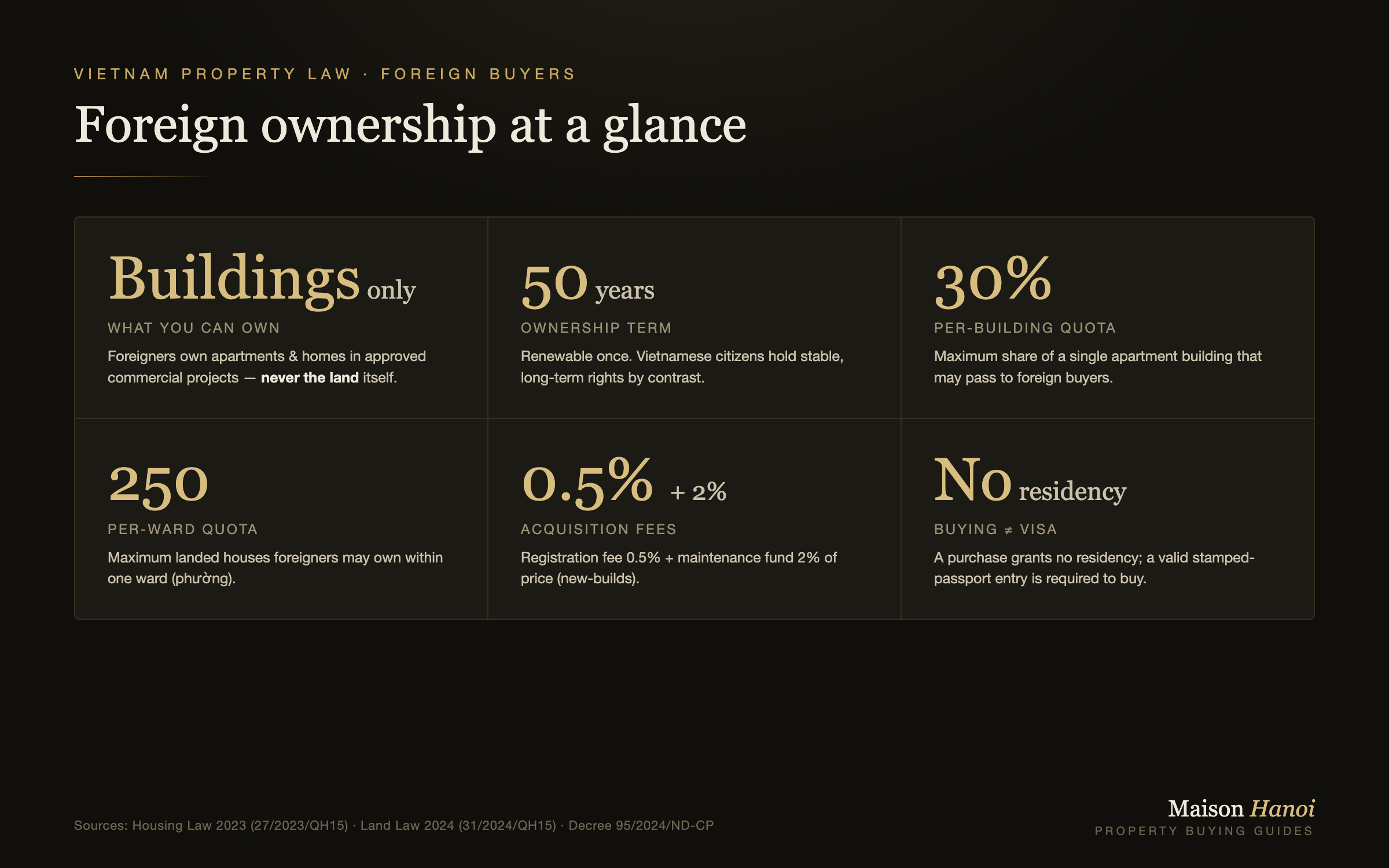
Il termine associato alla proprietà straniera è di 50 anni, rinnovabile una volta. I cittadini vietnamiti, al contrario, detengono i loro diritti d’uso residenziale su base stabile e praticamente indefinita. La differenza tra queste due posizioni — un termine fisso rinnovabile per gli stranieri, sicurezza a lungo termine per i locali — è la cosa più importante da comprendere prima di impegnarsi, ed è al centro della nostra guida completa all’acquisto di proprietà in Vietnam come straniero.
La proprietà è dimostrata dal Pink Book, non dal contratto di vendita. Fino a quando il certificato non viene emesso a tuo nome presso l’ufficio del catasto distrettuale, detieni un diritto contrattuale, non un titolo registrato. Poiché le categorie di beni che uno straniero può detenere sono limitate, conviene comprendere i tipi di proprietà aperti agli acquirenti stranieri prima di selezionare qualsiasi immobile — le regole differiscono nettamente tra appartamenti, case con terreno e terreni nudi.
Cosa possono acquistare gli stranieri — e come si confrontano Việt Kiều e locali
I cittadini stranieri possono acquistare edifici residenziali all’interno di progetti abitativi commerciali approvati per la proprietà straniera. In pratica ciò significa appartamenti in condomini idonei e, meno comunemente, case con terreno — ville e case a schiera — all’interno degli stessi progetti approvati. Non è possibile acquistare terreni agricoli, né un lotto sul mercato aperto per costruirci, né nulla in una zona militare o di sicurezza nazionale designata. Il progetto stesso deve essere idoneo: approvato dall’autorità locale, con quota straniera ancora disponibile.
Due quote regolano quanto di un progetto può passare in mani straniere. In un singolo edificio di appartamenti, gli stranieri possono possedere al massimo il 30% delle unità. In un dato quartiere (phường, circa 10.000 residenti), gli stranieri possono possedere al massimo 250 case con terreno. Una volta raggiunto uno di questi limiti, non è possibile alcun ulteriore acquisto straniero in quell’edificio o quartiere — acquistare oltre il limite non può produrre un Pink Book valido, quindi la verifica della quota è un passaggio imprescindibile, descritto nel nostro processo di acquisto passo dopo passo.
La situazione cambia per i Việt Kiều — vietnamiti all’estero. Dalla Legge sulla Terra 2024, i cittadini vietnamiti residenti all’estero e le persone di origine vietnamita detengono diritti quasi equivalenti a quelli dei cittadini residenti: in generale, possono detenere diritti d’uso del terreno su base a lungo termine e non sono soggetti alle quote del 30% e 250 per stranieri. Chi possiede un passaporto vietnamita è considerato cittadino a questi fini. La tabella sottostante riassume dove le tre posizioni divergono.
| Diritti | Cittadino straniero | Việt Kiều (vietnamiti all’estero) | Cittadino vietnamita |
|---|---|---|---|
| Possedere diritti d’uso del terreno | No — solo edifici | Sì, quasi cittadino (Legge sulla Terra 2024) | Sì |
| Acquistare appartamenti in progetti approvati | Sì, entro la quota | Sì | Sì |
| Termine di proprietà | 50 anni, rinnovabile una volta | Termine lungo/stabile | Termine lungo/stabile |
| Soggetto a quote 30% / 250 | Sì | No | No |
| Acquistare fuori dai progetti commerciali approvati | No | In generale sì | Sì |
Un ulteriore limite si applica a tutti: la Legge sul Commercio Immobiliare regola chi può vendere e a quali condizioni, motivo per cui un sviluppatore affidabile, un titolo pulito e una quota disponibile sono importanti quanto il prezzo indicato quando si valuta una specifica unità.
Regole sulla proprietà straniera in Vietnam a colpo d’occhio
Riferimento legale- Proprietà del terreno
- Non disponibile a nessuno
- Lo Stato detiene la terra; gli acquirenti acquisiscono diritti d’uso del terreno (Legge sulla Terra 2024)
- Cosa possono acquistare gli stranieri
- Edifici in progetti commerciali approvati
- Nessun terreno; niente in zone militari o di sicurezza (Legge sull’Abitazione 2023)
- Termine di proprietà straniera
- 50 anni, rinnovabile una volta
- Legge sull’Abitazione 2023
- Quota per edificio
- Massimo 30% degli appartamenti di un edificio
- Legge sull’Abitazione 2023
- Quota per quartiere
- Massimo 250 case con terreno per quartiere
- Quartiere ≈ 10.000 residenti
- Tassa di registrazione
- 0,5% del prezzo
- Acquirente, alla registrazione del Pink Book
- Residenza dall’acquisto
- Nessuna
- È richiesto un ingresso legale con passaporto timbrato per acquistare
- Mutuo locale
- Generalmente non disponibile ai non residenti
- Quadro del Decreto 95/2024
Esemplare: il Pink Book (Sổ hồng)
Come si garantisce la proprietà straniera, passo dopo passo
⏱ 3–6 mesi
La proprietà legale si costruisce in una sequenza fissa. Ogni passaggio protegge quello precedente, e il Pink Book alla fine è ciò che trasforma un contratto in titolo registrato.
- 1
Conferma la tua idoneità all’acquisto
⏱ Prima di iniziare
Devi essere entrato in Vietnam legalmente — un passaporto con un timbro di ingresso valido è il requisito di base. Conferma che l’immobile non si trovi in una zona militare o di sicurezza nazionale.
⚠Possedere una proprietà non conferisce residenza o visto — organizza il tuo status di immigrazione separatamente.
→ law firms - 2
Verifica l’approvazione del progetto e la quota straniera
⏱ 1–2 settimane
Controlla che lo sviluppo sia un progetto abitativo commerciale approvato e che la quota straniera del 30% per edificio (o 250 per quartiere) abbia ancora disponibilità. Questo è il passaggio che la maggior parte degli acquirenti salta e di cui poi si pente.
DocumentsDecisione di approvazione del progetto · Conferma della quota straniera da parte dello sviluppatore
⚠Acquistare una volta che la quota straniera del 30% di un edificio è piena non può produrre un titolo valido.
- 3
Firma del Contratto di Compravendita notarile
⏱ 2–4 settimane
Il SPA dovrebbe essere bilingue e notarile, con il prezzo indicato in đồng vietnamiti sia in lettere che in cifre, e un chiaro piano di pagamento legato a tappe di costruzione o consegna.
DocumentsSPA bilingue · Passaporto
→ law firms - 4
Registra e ricevi il tuo Pink Book
⏱ 1–3 mesi◈ 0,5% registrazione + 2% fondo di manutenzione
L’ufficio del catasto distrettuale registra i diritti d’uso del terreno e la proprietà dell’edificio a tuo nome ed emette il Sổ hồng per il termine di 50 anni. Solo ora detieni il titolo registrato.
DocumentsSổ hồng (Pink Book)
Domande frequenti
Uno straniero può acquistare proprietà a Hanoi?
Sì. I cittadini stranieri possono acquistare appartamenti — e alcune case con terreno — all’interno di progetti commerciali approvati per la proprietà straniera, entro la quota del 30% per edificio. La proprietà dura per un termine di 50 anni, rinnovabile una volta. Non puoi acquistare il terreno stesso o proprietà in zone militari o di sicurezza.
Un cittadino statunitense o americano può acquistare proprietà in Vietnam?
Sì. La Legge sull’Abitazione 2023 applica le stesse regole a tutti i cittadini stranieri indipendentemente dalla nazionalità — inclusi gli americani. Devi essere entrato in Vietnam legalmente con un passaporto timbrato. Non esiste una restrizione separata per i cittadini statunitensi né è richiesto il possesso di residenza per completare un acquisto.
Acquistare proprietà in Vietnam conferisce la residenza?
No. Possedere proprietà in Vietnam non conferisce diritto di residenza, visto né percorso verso la cittadinanza. Acquisti come visitatore con un timbro di ingresso valido, e gestisci il tuo status di immigrazione separatamente tramite i canali ordinari di visto turistico, business o lavoro.
Gli stranieri possono possedere terreni in Vietnam?
No — e neppure i cittadini vietnamiti nel senso occidentale. Tutta la terra è detenuta dallo Stato; gli acquirenti acquisiscono diritti d’uso del terreno registrati sul Pink Book. Gli stranieri possiedono l’edificio e detengono quei diritti d’uso per 50 anni, rinnovabili una volta, ma mai il suolo.
Una persona francese con radici vietnamite può acquistare terreno e costruire una casa?
Le persone di origine vietnamita — Việt Kiều — detengono diritti quasi equivalenti a quelli dei cittadini residenti dalla Legge sulla Terra 2024, e non sono soggette alle quote per stranieri. Chi possiede un passaporto vietnamita è considerato cittadino. Un avvocato autorizzato dovrebbe confermare il tuo esatto status prima di agire.
Come funziona realmente la proprietà immobiliare in Vietnam?
La proprietà è dimostrata dal Sổ hồng (Pink Book), il Certificato di Diritti d’Uso del Terreno e Proprietà. Registra chi detiene l’edificio e i diritti d’uso del terreno, lo scopo e il termine. Fino a quando non viene emesso a tuo nome presso l’ufficio del catasto distrettuale, detieni un contratto, non un titolo.
Cosa succede alla scadenza del termine di proprietà di 50 anni?
Il termine di proprietà straniera è rinnovabile una volta, estendendo i tuoi diritti oltre i 50 anni iniziali soggetti alla legge vigente al momento del rinnovo. È anche comune vendere a un cittadino vietnamita prima di allora. Copriamo i meccanismi nella nostra guida al limite di proprietà di 50 anni e al suo rinnovo.
Fonti
- Legge sull’Abitazione 2023 (Luật Nhà ở, No. 27/2023/QH15), in vigore dal 01/08/2024 — testo ufficiale in inglese, thuvienphapluat.vn
- Legge sulla Terra 2024 (Luật Đất đai, No. 31/2024/QH15), in vigore dal 01/08/2024 — testo ufficiale in inglese, thuvienphapluat.vn
- Legge sul Commercio Immobiliare 2023 (Luật Kinh doanh Bất động sản, No. 29/2023/QH15), in vigore dal 01/08/2024 — testo ufficiale in inglese, thuvienphapluat.vn
- Decreto 95/2024/ND-CP — decreto attuativo che definisce i dettagli della proprietà straniera secondo la Legge sull’Abitazione 2023 (citato per riferimento; nessun URL ufficiale verificato in inglese al momento della stesura).
Fai verificare la tua idoneità e il titolo prima di impegnarti
Il nostro desk consulenziale di Hanoi verifica le quote straniere, le approvazioni di progetto e lo stato del Pink Book per gli acquirenti potenziali. Richiedi un secondo parere indipendente e risponderemo entro 24 ore.